Which EnWave Partnership Model Fits Your Business?
The right EnWave partnership model depends on your stage, production goals, and level of process ownership. A startup may need product trials, an ingredient company may need an R&D license, and an established manufacturer may be ready for a REV™ commercial license and equipment purchase. EnWave’s model can combine process development, pilot access, equipment, licensing, and manufacturing relationships rather than relying on a single transaction.
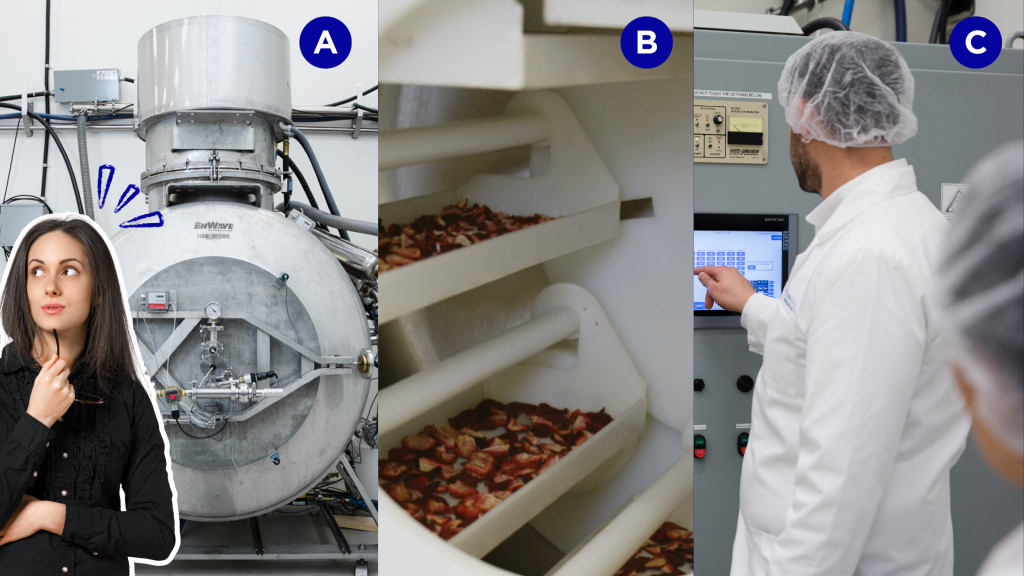
How do you choose the right EnWave partnership model?
You choose the right model by starting with the business question you need to answer. Are you testing whether a product can be dried, developing a proprietary process, validating several applications, or preparing to run dedicated production? The answer usually determines the most practical path.
A useful decision framework is below.
| Partner need | Potential pathway | Best fit |
|---|---|---|
| Test a new product quickly | Product trials or pilot access | Startups and R&D teams |
| Develop a proprietary process | R&D license and small-scale equipment | Ingredient innovators and research groups |
| Validate several applications | Technology evaluation and license option | Large food companies |
| Launch without building a line immediately | Licensed co-manufacturing | Emerging and scaling brands |
| Operate dedicated production | Commercial license plus REV™ equipment | Established manufacturers |
These pathways can also overlap. A company may begin with trials, move into an R&D license, and later enter a commercial license once the product and market are validated.
What happens during a REV™ development collaboration?
A REV™ development collaboration usually begins with the product and the commercial goal rather than the equipment. EnWave and the partner work through questions about the raw material, desired texture, final moisture, shelf life, production volume, and target market.
The collaboration may address:
- What product qualities must be preserved?
- Is the target texture crunchy, chewy, or powdered?
- What moisture level supports the desired shelf life?
- How sensitive are the ingredients to heat?
- What production volume is needed at launch?
- Does the process need batch or continuous operation?
This makes the development process practical. The goal is not simply to demonstrate that vacuum microwave drying works. It is to determine whether it can support a viable product and a repeatable production process.
Which partnership model fits a startup?
A startup often benefits from product trials, pilot access, or our co-manufacturing partners before purchasing equipment. This keeps the initial investment manageable while the company tests demand, packaging, pricing, and repeat purchase.
For an early-stage brand, the most important questions are usually:
- Can the product meet the sensory brief?
- Can it achieve the required shelf life?
- Will consumers pay for it?
- Can the product be made consistently?
- Is there enough demand to justify equipment ownership?
Pilot-scale food drying gives the team evidence before it commits to a larger structure. It can also provide samples for retailers, investors, and market testing. Once demand is established, the company can consider a commercial license, equipment purchase, or access to licensed manufacturing capacity.
Which model fits an ingredient company?
An ingredient company may need more control over formulation and process development than a consumer brand. An R&D license paired with small-scale REV™ equipment can be a strong fit because it allows the company to develop multiple applications and support its own customers.
This model can help ingredient innovators:
- Develop proprietary drying parameters.
- Test multiple raw materials and formulations.
- Produce samples for customer trials.
- Support collaborative product development.
- Build internal technical expertise.
An R&D license is especially relevant when the drying process itself is part of the company’s intellectual property or customer value proposition. Instead of outsourcing every test, the company can develop a repeatable platform for food innovation.
What is an EnWave R&D license?
An EnWave R&D license gives an organization defined rights to use REV™ technology for research, development, and related product work. The specific rights depend on the agreement, but the model can support process development, collaboration with third parties, and limited production for market trials.
This type of arrangement can suit food innovators, research groups, and companies that need to build long-term technical capability before entering full commercial production.
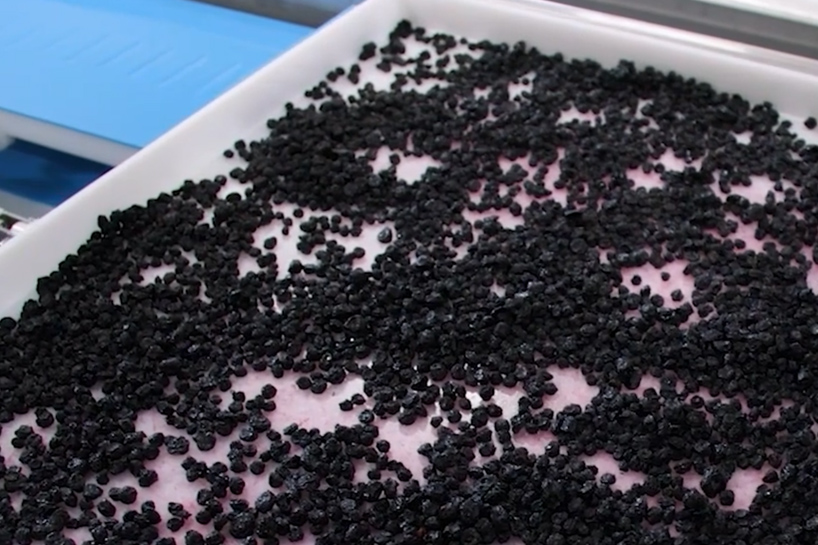
Which pathway fits a university or research group?
A university or research group may benefit from an R&D license and lab or pilot-scale REV™ equipment. This gives researchers access to a platform for applied studies, industry collaboration, and student or faculty projects.
The right arrangement should clarify:
- Which materials and applications can be studied.
- Whether external companies can use the facility.
- What type of product volumes are permitted.
- How intellectual property will be managed.
- Whether the facility will support future commercial partners.
For research organizations, the value is not limited to the equipment. It can include a platform for industry engagement and commercialization.
Which model fits a large food company?
A large food company with multiple categories may benefit from a technology evaluation and license option. This allows the company to test REV™ across several products before deciding which applications justify commercial licensing.
A commercial-scale drying evaluation can answer questions such as:
- Which categories benefit most from REV™?
- What quality improvements are commercially meaningful?
- Which products can support a licensing business case?
- How does REV™ compare with commercial freeze drying?
- What plant configuration would support regional production?
For a large organization, this approach can reduce internal risk. It creates space to evaluate several use cases before selecting a long-term pathway.
Which model fits an emerging brand?
An emerging brand that wants to launch quickly may benefit from licensed co-manufacturing or access to a manufacturing partner with REV™ equipment. This avoids the time and capital required to design, finance, and commission a dedicated production line.
The brand can focus on:
- Product positioning.
- Retail relationships.
- Marketing and consumer education.
- Packaging and demand planning.
- Sales and distribution.
A licensed manufacturer handles the processing side under an established production system. As volumes increase, the brand can later transition to its own equipment or negotiate a more direct commercial license.
This is useful for products where speed to market matters more than immediate ownership.
When should a company consider a REV™ commercial license?
A company should consider a REV™ commercial license when the product, market, and production plan are sufficiently validated. A commercial license usually makes more sense when the company is prepared to operate dedicated REV™ equipment or organize production through an authorized manufacturing partner.
The decision may be appropriate when:
- Product trials meet the quality brief.
- Shelf life and packaging are validated.
- Customer demand is visible.
- Forecasted volume supports investment.
- The company has a suitable production site.
- The team is ready to manage operations and quality systems.
EnWave’s commercial license agreements can include territorial or application-specific rights, equipment requirements, and royalty obligations. For example, Solve Solutions received rights to use REV™ for specified products in Brazil alongside a 10kW machine purchase and requirements connected to larger-scale production.
The exact terms vary, so companies should evaluate them with appropriate legal, financial, and technical advisors.
What does a dehydration equipment purchase involve?
A dehydration equipment purchase involves more than buying machinery. The buyer must plan for site requirements, utilities, operators, maintenance, food safety, process validation, and production scheduling.
Before purchasing microwave drying equipment, teams should confirm:
- The target throughput.
- Product loading and unloading requirements.
- Batch or continuous processing needs.
- Facility layout and utilities.
- Operator training.
- Quality and food safety procedures.
- Spare parts and service support.
- Expansion plans.
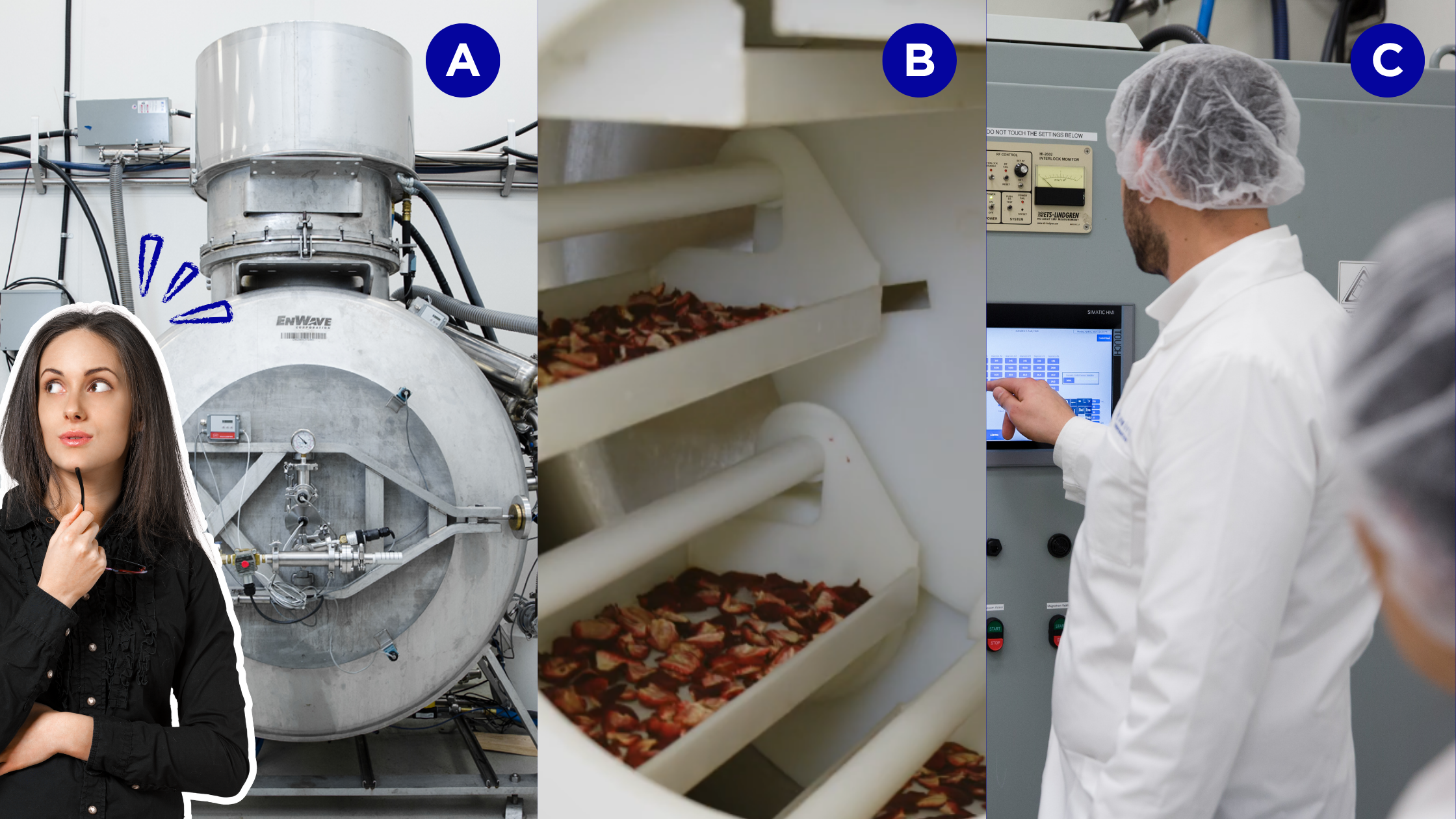
A pilot-scale unit can support process development, while larger REV™ equipment can support dedicated commercial food drying. The correct configuration depends on the product, volume, and operating model.
How does EnWave compare with a conventional equipment sale?
EnWave’s model can extend beyond a conventional equipment sale because it combines technology rights, process knowledge, equipment, and commercial support. That gives partners a pathway for developing and scaling products rather than simply taking delivery of a machine.
The relationship may include:
- Product and process trials.
- Technical consultation.
- Equipment purchase.
- An R&D license.
- A technology evaluation agreement.
- A commercial license.
- Connections to licensed manufacturing resources.
EnWave licensed partners use REV™ machinery and technical guidance to develop food products and ingredients across multiple markets. The partnership structure is designed to reflect the partner’s level of readiness.
How does REV™ compare with commercial freeze drying?
REV™ can be an alternative to commercial freeze drying when a company needs shorter processing cycles, lower-temperature dehydration, and scalable throughput. Freeze drying remains useful for certain products, but its cycle times and capital requirements may not fit every commercial plan.
Vacuum microwave drying combines vacuum conditions with microwave energy. Under vacuum, water can evaporate at lower temperatures, while microwave energy heats the material volumetrically. This can support faster moisture removal and better control over final product quality.
The right comparison should be product-specific. Teams should evaluate:
- Final texture.
- Colour and flavour.
- Nutrient retention.
- Moisture uniformity.
- Cycle time.
- Energy use.
- Equipment footprint.
- Cost per kilogram.
- Production scale.
A partnership with EnWave can help the team test these factors before selecting a long-term model.
What should you prepare before contacting EnWave?
You should prepare a clear product brief and a defined commercial objective before contacting EnWave. The more specific the starting information, the more productive the initial discussion will be.
Useful information includes:
- Raw material and formulation.
- Starting moisture content.
- Desired final moisture.
- Target texture.
- Target shelf life.
- Expected annual volume.
- Intended market or territory.
- Current production method.
- Packaging format.
- Comparison with commercial freeze drying or other methods.
You do not need to have every answer. Early conversations are designed to clarify feasibility and identify the most suitable next step. A strong technical discussion can reveal whether you need a product trial, an R&D license, a technology evaluation, or a commercial license.
How should companies move from evaluation to commercialization?
Companies should move from evaluation to commercialization only after confirming technical performance and business fit. A successful sample is important, but it is not enough on its own.
A responsible decision process includes:
- Confirm the product meets sensory and quality requirements.
- Validate moisture, water activity, and shelf life.
- Test packaging and distribution conditions.
- Confirm production throughput and yield.
- Build a cost model.
- Review regulatory and food safety requirements.
- Choose the appropriate licensing or manufacturing pathway.
This process helps align technology with the actual operating plan. It also gives internal stakeholders the evidence needed to support a larger investment.
Conclusion
There is no single EnWave partnership model for every company. Startups may need trials or co-manufacturing, ingredient companies may benefit from an R&D license, universities may require research rights and pilot equipment, and established manufacturers may be ready for a REV™ commercial license and dedicated machinery.
The best route matches the partnership to the company’s stage, risk tolerance, and production goals. EnWave’s broader model can connect pilot-scale food drying, process development, licensing, equipment purchase, and commercial manufacturing access.
The practical rule is simple. Start with the question your business needs to answer, then choose the partnership structure that gives you the right evidence, control, and path to scale.
FAQ
What type of EnWave partnership is right for a startup?
A startup may be best suited to product trials, pilot access, or licensed co-manufacturing before purchasing equipment or entering a commercial license.
What is an EnWave technology evaluation agreement?
It is an arrangement that allows a company to evaluate REV™ technology across one or more applications before exercising an option to negotiate commercial licenses.
What is an EnWave R&D license?
An EnWave R&D license provides rights to use REV™ for research, process development, collaboration, and sometimes limited market-trial production, depending on the agreement.
When should a company purchase REV™ equipment?
A company should consider purchasing REV™ equipment after validating product quality, shelf life, throughput, demand, and the economics of dedicated production.
Does EnWave offer equipment rental?
Equipment access depends on the specific program and commercial arrangement. Companies should ask EnWave about available pilot access, trials, or other options rather than assuming a standard rental model.
How does a REV™ commercial license work?
A REV™ commercial license grants defined rights to use EnWave’s patented technology, often by territory, product category, or application, and may be paired with equipment purchase and royalty obligations.
Can a company start with product trials and later license REV™?
Yes. Product trials can help validate quality and market fit before a company moves into an R&D license, technology evaluation, equipment purchase, or commercial license.
How does EnWave compare with commercial freeze drying?
REV™ can offer a faster and potentially more scalable alternative for applications where cycle time, quality retention, and commercial throughput are important. The comparison should be based on the specific product and production requirements.
Further reading
EnWave technology evaluation and license option agreement
EnWave R&D license with Rhizome Food and Farming
EnWave R&D license and equipment purchase with Teagasc
EnWave commercial license with Solve Solutions
EnWave commercial license with The Dry Hub