

The Rise of Benefit Stacking in Functional Food Innovation

Benefit stacking is the design of one food, beverage, supplement, or nutraceutical around multiple complementary consumer benefits or use occasions. A product might combine protein, fiber, convenient nutrition, and digestive-health positioning rather than relying on one “hero” ingredient.
The term is gaining traction in food-industry and consumer-trend discussions, but it is not a standardized scientific or regulatory category. Ardent Mills describes benefit stacking as a consumer mindset centered on getting more nutritional value from each bite, while Food Dive has documented the term in connection with protein, gut health, and sugar reduction in yogurt innovation.
Importantly, combining ingredients does not automatically demonstrate combined efficacy. Every ingredient, finished-product claim, dose, processing condition, and interaction still requires appropriate evidence.

What is benefit stacking in functional foods and supplements?
Benefit stacking turns a single product into a more complete solution for a defined consumer need. Instead of developing “a protein snack” or “an energy supplement,” an innovation team might develop a portable afternoon snack that provides protein, fiber, appealing texture, and a carefully substantiated energy or focus proposition.
This approach can apply across:
- Functional foods and beverages
- Multifunctional supplements
- Protein and recovery products
- Beauty supplements
- Active nutrition
- Personalized nutrition concepts
- Functional ingredients for use in other formulations
Benefit stacking should not mean adding as many ingredients as possible. The strongest products have one clear primary job, supported by secondary benefits that are relevant to the same consumer and use occasion.
For example, high protein, digestive-health positioning, and reduced sugar can fit naturally within a yogurt or nutrition snack. By contrast, adding unrelated botanicals simply to increase the number of front-of-pack claims can create formulation, substantiation, and consumer-trust problems.
Why are consumers and brands moving toward multifunctionality?
Consumers increasingly expect food and nutrition products to offer value beyond basic hunger or convenience. Industry reporting on benefit stacking points to interest in nutrient density, protein, gut health, lower sugar, and products that support several wellness priorities at once.fooddive
This reflects several connected functional food trends.
Convenience without a crowded routine
A multifunctional product may fit more easily into daily life than a collection of separate foods, powders, capsules, or beverages. That does not mean fewer products will always provide equivalent nutrition or efficacy. It does explain the appeal of wellness formulations that consolidate complementary functions into one format.
A more holistic view of wellness
Consumers often do not experience energy, digestion, sleep, recovery, and appearance as isolated concerns. Brands are responding with concepts that connect benefits around a time of day, life stage, activity, or lifestyle objective.
Higher expectations for every serving
Ardent Mills’ use of “benefit stacking” emphasizes consumers’ desire to receive more nutritional value from each eating occasion. Food Dive similarly reports interest in products that combine attributes such as protein, gut-health positioning, and lower sugar rather than relying on a single differentiator.
These findings support the direction of the trend. They do not establish that every benefit-stacked product is effective, nutritionally superior, or appropriate for every consumer.
Which benefit combinations have the strongest product-development logic?
The most credible combinations share a clear consumer job, compatible ingredients, an achievable dose, and claims that can be supported for the finished product.
| Benefit combination | Consumer proposition | Key formulation considerations |
|---|---|---|
| Protein plus recovery | Post-activity nutrition in a convenient format | Protein quality and dose, texture, flavor masking, oxidation, serving size, and whether any recovery claim is supported |
| Energy plus focus | A defined daytime use occasion | Total stimulant load, ingredient interactions, bitterness, solubility, serving limits, and regulatory treatment |
| Gut health plus broader nutrition | Daily food or beverage with protein, fiber, prebiotics, or probiotics | Fiber tolerance, probiotic strain stability, pH, moisture, oxygen, processing temperature, and end-of-shelf-life specifications |
| Beauty plus gut health | A beauty-from-within or wellness concept | Evidence for each ingredient and claim, dose, taste, oxidation, bioavailability, and whether the combined proposition has finished-product support |
| Protein plus immunity | A nutrient-dense food or supplement concept | Avoiding vague immunity promises, validating nutrient-content conditions, managing flavor and stability, and separating protein claims from immune claims |
Protein, fiber, lower sugar, and digestive-health positioning currently have clear relevance in food innovation discussions. Other combinations, including beauty plus gut health or sleep plus recovery, may be commercially interesting but should be treated as formulation concepts, not assumed physiological synergies.
The FTC specifically warns that evidence for individual ingredients may not substantiate a combination product when ingredients could interact differently together. Evidence must also match the formulation, dose, delivery format, target population, and advertised outcome.
Why does benefit stacking make formulation more difficult?
Every additional functional ingredient changes the formulation environment. It can affect taste, color, solubility, viscosity, pH, texture, moisture migration, oxidation, and shelf life.
A promising concept can fail if:
- The evidence-backed dose will not fit into a practical serving
- A botanical or mineral creates excessive bitterness or astringency
- Proteins or fibers change beverage viscosity or sedimentation
- Ingredients react at the product’s target pH
- Oils, pigments, or vitamins oxidize during processing or storage
- Hygroscopic powders absorb moisture and begin to cake
- Components with different particle sizes segregate during handling
- Heat-sensitive ingredients lose potency during processing
- Live cultures fail to meet their specification at the end of shelf life
- Packaging does not provide the required oxygen, moisture, or light barrier
Water activity deserves particular attention. It describes the availability of water in a food rather than only the total amount of moisture. FDA guidance explains that water activity affects food stability and must be brought to a suitable level during drying and maintained during storage.
There is no universal moisture or water-activity target for every benefit-stacked product. Targets should be established for the specific matrix, ingredients, texture, safety requirements, packaging, and intended shelf life.
How can processing affect sensitive functional ingredients?
Processing conditions can change the amount, activity, or physical behavior of a functional ingredient. Temperature, oxygen exposure, processing time, moisture, product geometry, food matrix, and storage conditions can all influence the outcome.
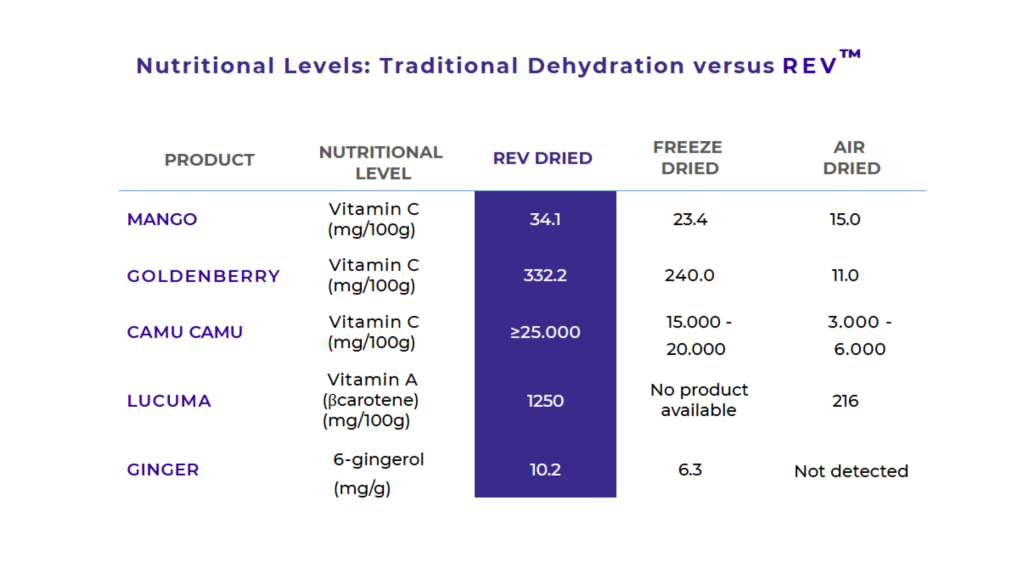
However, ingredient stability is product-specific. A result for vitamin C in orange pieces should not be generalized to probiotics, proteins, polyphenols, enzymes, or another botanical extract.
A 2020 University of British Columbia study compared REV™, freeze drying, and air drying for broccoli, oranges, and carrots. Under the protocols studied, REV™ significantly shortened processing time, retained more vitamin C and beta-carotene than air drying, and produced results competitive with freeze drying for those measured nutrients. Freeze-dried samples had the best rehydration properties, while REV™ samples received the highest sensory scores. Nutrient values in the REV™ samples still declined during accelerated storage, reinforcing that shelf stability must be validated rather than assumed.
Freeze drying remains an important benchmark for sensitive and high-value products because low-temperature sublimation can preserve structure, flavor, and selected bioactive compounds. Its limitations can include long processing cycles, high energy requirements, batch operation, and significant capital or operating costs.
The correct processing route therefore depends on the ingredient, evidence target, desired texture, product format, throughput, rehydration needs, packaging, shelf life, and commercial economics.
How does REV™ vacuum microwave dehydration work?
REV™ combines microwave energy with reduced pressure to remove moisture under controlled conditions. The vacuum lowers the boiling point of water, while microwave energy supports volumetric heating within the product. Pressure and microwave power can be adjusted to manage product temperature and the final moisture endpoint.
This differs from commercial freeze drying. Freeze drying first freezes the product and then removes ice primarily through sublimation under low pressure. REV™ generally removes liquid water under vacuum while microwave energy drives evaporation.
For benefit-stacked product development, REV™ may be evaluated for formats such as:
- Shelf-stable powders
- Fruit, vegetable, dairy, or protein fragments
- Functional inclusions
- Crisp snacks
- Ingredients for bars and cereals
- Components for beverage or supplement formulations
REV™ should not be positioned as universally preserving every nutrient, probiotic, enzyme, or bioactive. Performance depends on the formulation, ingredient sensitivity, loading pattern, process parameters, target endpoint, and subsequent storage.
Why should processing be selected during formulation?
Processing is part of the formula’s performance, not a finishing step. A formulation that works in the beaker may change substantially when dried, milled, blended, rehydrated, packaged, or scaled.
A benefit-stacked concept can lose credibility if processing degrades a highlighted ingredient, creates poor flavor, changes color, produces uneven texture, or leaves an unstable water activity. The same is true when milling or blending causes segregation and consumers no longer receive a consistent amount per serving.
As the development flow below illustrates, consumer need, evidence, compatibility, drying, packaging, claims, and scale-up should be managed as one connected system. EnWave similarly recommends establishing moisture, water-activity, sensory, packaging, and storage targets through testing before production scale-up. FTC guidance adds that objective claims must be supported by evidence relevant to the actual product and advertised benefit.
How can teams develop a benefit-stacked product responsibly?
A practical nutrition product innovation process follows ten steps.
- Define the primary consumer jobStart with the occasion and problem the product is intended to address.
- Choose complementary secondary benefitsAdd only benefits that strengthen the primary proposition.
- Select evidence-backed ingredientsVerify ingredient identity, dose, form, target population, safety, and evidence quality.
- Check compatibility earlyEvaluate pH, solubility, taste, color, oxidation, moisture sensitivity, heat sensitivity, particle size, bioavailability, and potential interactions.
- Select the right formatDecide whether the concept works best as a beverage, powder, inclusion, snack, bar, gummy, capsule, or functional ingredient.
- Choose the processing routeCompare air drying, spray drying, commercial freeze drying, REV™ vacuum microwave dehydration, and other methods against the actual product requirements.
- Set measurable endpointsEstablish specifications for moisture, water activity, potency or viable count where applicable, texture, color, and sensory quality.
- Validate packaging and shelf lifeTest the finished product in its intended package under realistic storage conditions.
- Substantiate every express and implied claimReview nutrient-content, structure/function, health, performance, and disease-related implications separately.
- Plan scale-up before launchConfirm repeatability, throughput, product uniformity, cleaning requirements, economics, and quality controls.
What should brands know about functional claims?
In the United States, FDA distinguishes among nutrient-content claims, health claims, and structure/function claims. Dietary-supplement structure/function claims must be truthful and not misleading, supported by substantiation, notified to FDA no later than 30 days after marketing, and accompanied by the required disclaimer. Disease-treatment or prevention claims fall outside that pathway.
FTC requirements apply to advertising and the overall impression created by webpages, social media, packaging, visuals, endorsements, and other marketing. Objective health claims require adequate substantiation, generally in the form of competent and reliable scientific evidence. A disclaimer cannot correct an otherwise deceptive claim.
Canada has a separate framework. Supplemented foods must comply with permitted food categories, permitted supplemental ingredients, maximum amounts, labeling requirements, and applicable cautionary statements. Health claims must be truthful, not misleading, and supported before use; certain disease-related claims require premarket assessment.
Benefit stacking therefore increases the regulatory workload. Each benefit must be reviewed independently, and the combination may create new implied claims. This is high-level information, not legal advice.
Where does benefit stacking go next?
Benefit stacking is likely to remain useful language for functional product innovation because it connects consumer need, nutrition, format, and convenience. But long-term credibility will depend on disciplined product development rather than the number of claims on the package.
The opportunity is not to build products that promise everything. It is to create foods, beverages, multifunctional supplements, and functional ingredients that perform their primary job well, add relevant secondary value, and remain stable through processing and shelf life.
For food innovators, supplement brands, R&D teams, ingredient processors, and commercial decision-makers evaluating new functional formats, REV™ provides another processing route to test alongside air drying, spray drying, and commercial freeze drying.
Talk with EnWave about product trials, functional ingredient processing, commercial food drying, microwave drying equipment, and a scalable path from early development to production.
Frequently Asked Questions
What does benefit stacking mean?
Benefit stacking means designing one product to address multiple complementary consumer benefits or use occasions. It is emerging industry language rather than a formal scientific or regulatory category.
Does combining functional ingredients make a product more effective?
Not automatically. Evidence for ingredients used separately may not establish the safety or efficacy of the combination or the finished product.ftc
Which benefits pair naturally?
The strongest pairings share a consumer occasion and compatible technical requirements. Current food-industry examples emphasize protein, fiber, gut-health positioning, and lower sugar.
How does processing affect functional ingredients?
Temperature, oxygen, moisture, processing time, matrix, and storage can affect stability. The result must be validated for the specific ingredient and finished formulation.
Is freeze drying necessary for sensitive ingredients?
Not always. Freeze drying can be highly effective, but the best method depends on ingredient sensitivity, desired format, rehydration, sensory quality, throughput, shelf life, and economics.mdpi
How does vacuum microwave drying differ from freeze drying?
Freeze drying removes ice through sublimation. REV™ uses reduced pressure and microwave energy to support controlled evaporation and moisture removal within the product.enwave
How should multi-benefit claims be substantiated?
Brands should identify every express and implied claim, then confirm that the evidence matches the finished product, formulation, dose, population, delivery format, and claimed outcome.
Further Reading
- FDA Structure and Function Claims8548f96633.png
- FTC Health Products Compliance Guidance
- Health Canada Supplemented Foods Regulations Guidance
- Mohammadi et al. 2020
- Freeze-Drying Technology in the Food Industry
- Food Dive on Benefit Stacking
- Ardent Mills Benefit Stacking
- EnWave on REV™ and Shelf-Life Development
- EnWave REV™ Technology


