

How to Start a Dried Food Product Business in Canada

Starting a dried food product business in Canada means connecting concept, R&D, and processing in a clear path from idea to retail. Entrepreneurs can use food innovation labs, university facilities, and co-manufacturing partners to test and validate products before committing to full-scale equipment. EnWave helps connect brands with qualified manufacturing partners that utilize REV™ technology, reducing time-to-market for new dried snack products.

Why is Canada’s food innovation ecosystem growing?
Canada’s food innovation ecosystem is growing because of strong support for advanced processing, local ingredients, and tech-enabled food manufacturing. Programs like FIRSt in Toronto, NAIT’s Centre for Culinary Innovation in Alberta, and provincial centres provide R&D access that was once limited to large companies.
This network helps startups and established brands move from concept to commercialization with less risk. It also positions Canada as a hub for food tech, alt-proteins, and value-added processing. For dried food product development, that means more options for testing, refining, and scaling new products.
What resources are available for new food product development in Canada?
Resources for new food product development in Canada include food innovation labs, university research centres, and toll prResources for new food product development in Canada include food innovation labs, university research centres, and co-manufacturing partners. FIRSt at George Brown Polytechnic offers scientific R&D, product optimization, and shelf-life validation for food and beverage companies.
Other key resources include:
- NAIT’s Centre for Culinary Innovation for bench-top development and local ingredient focus.
- Manitoba’s Food Development Centre for pilot-scale equipment and regulatory guidance.
- EnWave’s network of co-manufacturing partners for REV™ technology trials and commercial production.
Together, these form a pathway from idea to market-ready product.
How do food innovation labs in Canada help startups?
Food innovation labs in Canada help startups by providing access to equipment, expertise, and testing that would be too costly to build in-house. FIRSt, for example, supports product and recipe development, consumer sensory research, and shelf-life validation.
These services allow entrepreneurs to:
- Troubleshoot formulation challenges.
- Optimize texture, flavor, and nutrition.
- Validate shelf life and packaging.
- Run pilot trials before full production.
For dried food product development, this reduces the risk of launching a product that cannot scale or meet quality expectations.
What role do university labs and provincial programs play?
University labs and provincial programs play a key role by bridging culinary creativity with food science. NAIT’s Centre for Culinary Innovation blends recipe development with ingredient characterization and taste panel evaluations.
Provincial programs like Manitoba’s Food Development Centre provide hands-on support for companies working with plant or animal proteins. They offer pilot-scale equipment, formulation support, and help navigating Canadian and U.S. regulatory requirements.
These resources are especially valuable for brands that need to prove their concept before pursuing commercial production through a co-manufacturing partner, licensing agreement, or equipment investment.
How does co-manufacturing fit into the commercialization pathway?
Co-manufacturing fits into the commercialization pathway by allowing brands to produce commercial-quality products without owning equipment or operating their own production facility. Through EnWave’s network of qualified manufacturing partners, companies can access commercial REV™ processing capacity while focusing on product development, sales, and brand growth.
This model supports:
- Small-batch runs for test marketing.
- Process validation and optimization.
- Packaging trials under real manufacturing conditions.
- A lower barrier to commercial production before licensing or equipment purchase.
For entrepreneurs, co-manufacturing is a practical way to validate demand and refine products before making major capital investments.
What are EnWave’s co-manufacturing opportunities and how do they work?
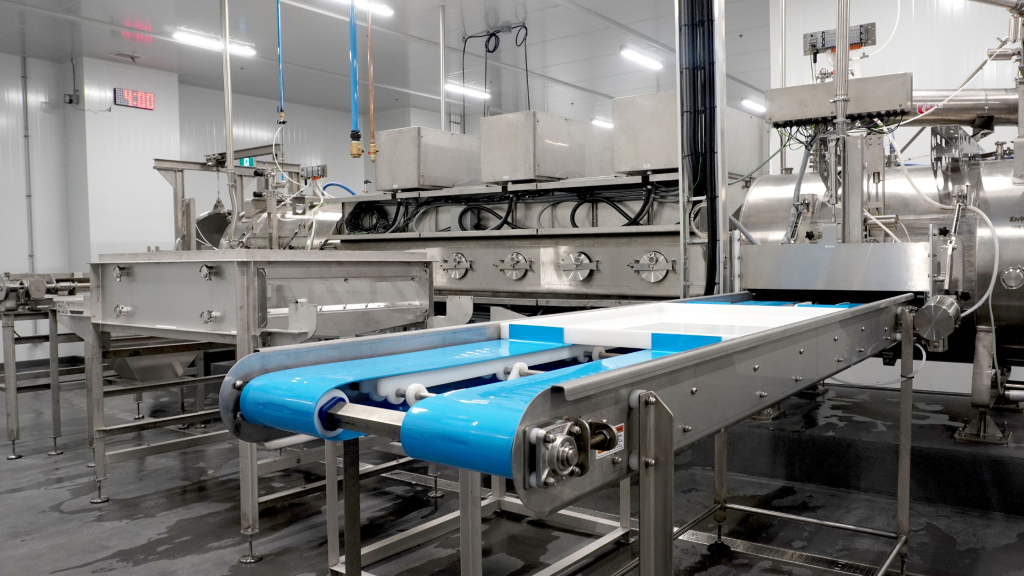
EnWave works with manufacturing partners that operate REV™ technology to help brands access commercial production capacity without purchasing equipment. These partners provide production expertise, quality systems, and manufacturing infrastructure while enabling companies to bring innovative dried food products to market.
Brands can work with EnWave and its manufacturing network to identify an appropriate production partner based on product type, volume requirements, and commercialization goals.
The goal is to accelerate commercialization with less upfront risk.
How can entrepreneurs combine R&D, pilot trials, and co-manufacturing?
Entrepreneurs can combine R&D, pilot trials, and co-manufacturing by using food innovation labs for formulation and then working with manufacturing partners for validation and commercial production.
A typical path might start at FIRSt or a university lab for recipe development and sensory testing.
Once the formulation is stable, the brand can work with EnWave to identify a suitable manufacturing partner utilizing REV™ technology. This allows the team to:
- Test moisture levels and texture.
- Validate shelf life and packaging.
- Produce commercial batches for market feedback.
- Prepare for licensing or equipment purchase.
This step-by-step approach aligns investment with actual demand.
Why is vacuum microwave drying technology relevant?
Vacuum microwave drying technology is relevant because it offers faster, lower-temperature dehydration with strong quality retention. REV™ combines vacuum and microwave energy to dry products in 10 to 60 minutes rather than hours or days.
For dried food product development, this means:
- Better retention of color, flavor, and nutrients.
- More consistent texture and moisture control.
- Ability to handle fruits, vegetables, meats, dairy, and grains.
- Scalability from pilot to industrial production.
This makes it a strong fit for brands targeting premium, functional, or clean-label snacks.
How does this support Canadian food manufacturing?
This supports Canadian food manufacturing by giving local brands access to advanced processing capabilities through established manufacturing partners. Rather than investing immediately in specialized equipment, startups can leverage existing production infrastructure while validating demand and scaling their business.
For food tech in Canada, this strengthens commercialization pathways and helps innovative products reach market faster.
What are the steps from concept to retail?
The steps from concept to retail typically include:
- Concept and formulation at a food innovation lab.
- Sensory and shelf-life testing with lab support.
- Pilot trials and product validation.
- Commercial production through a co-manufacturing partner.
- Scaling through licensing or equipment purchase.
Each step builds confidence and reduces risk before the next investment.
Why choose a Canadian co-manufacturing partner?
Choosing a Canadian co-manufacturing partner offers advantages in proximity, communication, and regulatory alignment. Brands can collaborate closely with manufacturing teams, optimize products quickly, and streamline commercialization efforts.
It also simplifies logistics for Canadian food manufacturing. Products can be manufactured, packaged, and distributed within the same region, reducing lead times and freight costs.
For startups, that speed and flexibility can be decisive.
How does this reduce time-to-market?
This reduces time-to-market by allowing brands to access established commercial production capacity immediately. Instead of waiting for equipment procurement and installation, companies can begin manufacturing through qualified partners while continuing to develop distribution and sales channels.
The result is a faster path from concept to retail. Brands can gather consumer feedback, refine the product, and scale with confidence.
Conclusion
Starting a dried food product business in Canada means leveraging the country’s food innovation ecosystem to move from concept to retail with less risk. Food innovation labs, university facilities, and co-manufacturing partners provide the R&D, pilot testing, and production capacity that startups need.
For brands focused on dried food product development, EnWave can help connect them with qualified manufacturing partners utilizing advanced REV™ technology. The key takeaway is simple: great ideas become successful products when innovation, manufacturing, and commercialization work together.
FAQ
What is a food innovation lab in Canada?
A food innovation lab in Canada is a facility that provides R&D, product development, and testing services for food and beverage companies, such as FIRSt at George Brown Polytechnic.
How can startups access dried food product development support?
Startups can access support through labs like FIRSt, university centres like NAIT, and toll drying services like REVworx™ for pilot and commercial runs.
What is co-manufacturing?
Co-manufacturing is a production arrangement where a third-party manufacturer produces products on behalf of a brand, allowing companies to commercialize products without owning manufacturing equipment.
How does REVworx™ help new food product development?
REVworx™ provides vacuum microwave drying trials and small-batch production that reduce time-to-market and upfront risk for new dried snack products.
Why is vacuum microwave drying relevant for dried foods?
Vacuum microwave drying offers faster, lower-temperature dehydration with strong quality retention, making it suitable for premium and functional dried products.
How does EnWave help new food product development?
EnWave supports product development through technical expertise and by connecting brands with manufacturing partners that utilize REV™ technology for commercial production.
Can entrepreneurs scale after using co-manufacturing?
Yes. Brands can use co-manufacturing to validate their products and market demand before transitioning to licensing agreements or equipment ownership as they grow.
Further reading
Food Innovation and Research Studio (FIRSt)
https://www.georgebrown.ca/research-innovation/research-institutes/first
FIRSt What is FIRSt
https://www.georgebrown.ca/research-innovation/research-institutes/first/about
NAIT Centre for Culinary Innovation
Manitoba Food Development Centre
https://granthub.ca/guide/food-development-centre
EnWave What Canada’s top FoodTech innovators have in common
EnWave How drying streamlines supply chain challenges
Vitafoods Insights REV the next frontier in functional ingredient drying