

How to Evaluate Moisture Control in Food Dryers
If you are comparing industrial dehydration equipment, moisture control should be one of the first things you evaluate. It affects shelf life, safety, texture, nutrition, and whether your process will scale without creating costly batch variation. Moisture content alone is not enough. You also need to look at water activity, drying uniformity, the controls built into the equipment, and how consistently the system performs from one run to the next.
For food processing teams, the best industrial drying systems do more than remove water. They help you hit a target moisture range reliably, reduce uneven drying, and support product innovation without slowing down production. That is where newer dehydration technology can look very different from air drying, oven drying, or even commercial freeze drying.
Why is moisture control so important in food processing equipment
Moisture control matters because it shapes product safety, texture, shelf life, and consistency. A dried product that looks fine on the outside can still have too much available water inside, which creates quality and stability problems later.
This is why food processors track both moisture content and water activity. Moisture content tells you how much water is left in the product. Water activity tells you how much of that water is available for microbial growth and quality loss. Foods with the same moisture content can still behave very differently depending on water activity.
That distinction is especially important when you are choosing food processing equipment for commercial use. If your system only dries to a broad average and does not control moisture evenly, you may end up with one part of the batch overdried and another part still too wet.
What should you measure when comparing industrial dehydration equipment
Start with the numbers that directly affect product performance. The most useful comparison points are residual moisture content, water activity, temperature control, drying time, and moisture uniformity across the tray or product bed.
Water activity is especially useful because it connects drying performance to food safety and shelf stability. University of Minnesota Extension notes that foods with a water activity of 0.85 or less have a lower risk of bacterial survival and growth when properly prepared and stored, while properly dehydrated fruit can reach around 0.60. Kansas State also notes that water activity affects odor, color, flavor, texture, and shelf life.
For product teams, the practical takeaway is simple. Ask whether the dryer can repeatedly hit your target moisture window and your target water activity, not just whether it can dry the product. That is the difference between a lab success and a repeatable production process. This recommendation reflects the quality and safety principles described in the sources above.
Why does drying uniformity matter so much for batch production
Drying uniformity matters because it determines whether every piece in the batch performs the same way in storage, packaging, and eating quality. When moisture is uneven, you do not really have one finished product. You have several different ones in the same batch.
A published review on microwave drying explains that nonuniform heating can be caused by product geometry, composition, and uneven electromagnetic field distribution. A 2025 MDPI study on dynamic microwave pulsing reported improved temperature and moisture uniformity when the system adjusted power based on internal temperature feedback rather than running on a fixed cycle.
In commercial terms, better uniformity means fewer rejects, more predictable texture, and less risk that the wettest pieces will set the shelf life for the entire batch. That is why industrial machinery should be judged not only by how fast it dries, but by how evenly it dries.
How do traditional drying methods compare on moisture control
Traditional drying methods can work, but they often force tradeoffs. Air drying is widely used because it is familiar and simple, yet it can be very slow and vulnerable to inconsistency. Freeze drying preserves quality well, but it can be expensive, energy intensive, and slower to scale. Oven drying is easier to access, but it can create uneven heat exposure and higher risk of over-drying.
Air drying is prone to inconsistency and prolonged exposure, freeze drying as high in nutrient retention but costly and energy intensive, and oven drying as vulnerable to uneven heat distribution and quality loss. Those are useful considerations for any team evaluating commercial food drying systems for R&D or scale-up.
This does not mean one legacy method is always wrong. It means the right choice depends on your product requirements. If moisture control, throughput, and batch consistency are central to your product brief, you need to look closely at how the equipment actually manages heat and water removal across the whole run.
How does microwave based dehydration technology improve moisture control
Microwave based dehydration technology approaches moisture removal differently because it heats water within the product rather than relying only on surface heat transfer. REV by combining vacuum with microwave energy allows operators to control both product temperature and final moisture, while promoting a more uniform dehydration process through volumetric energy transfer.
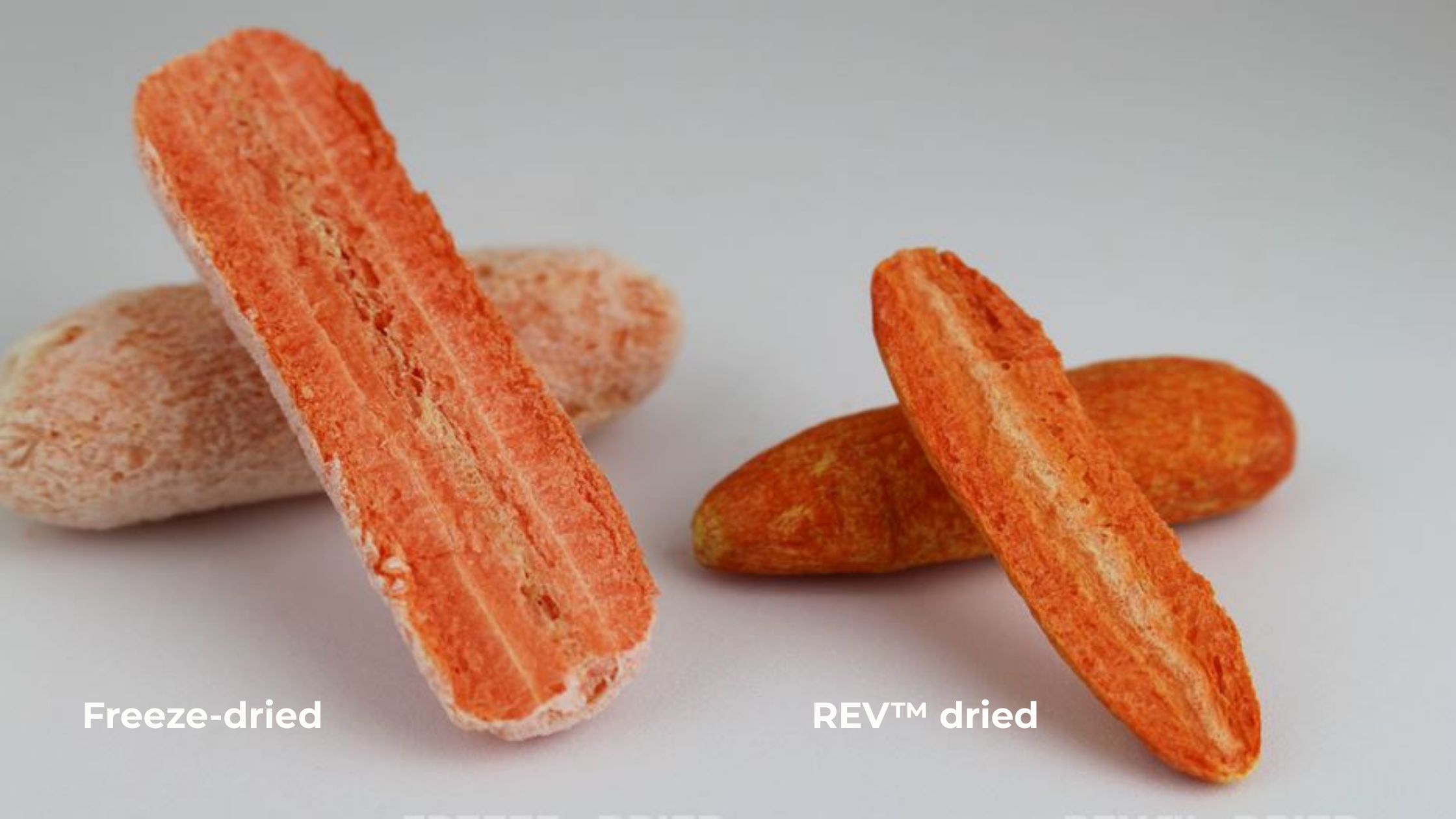
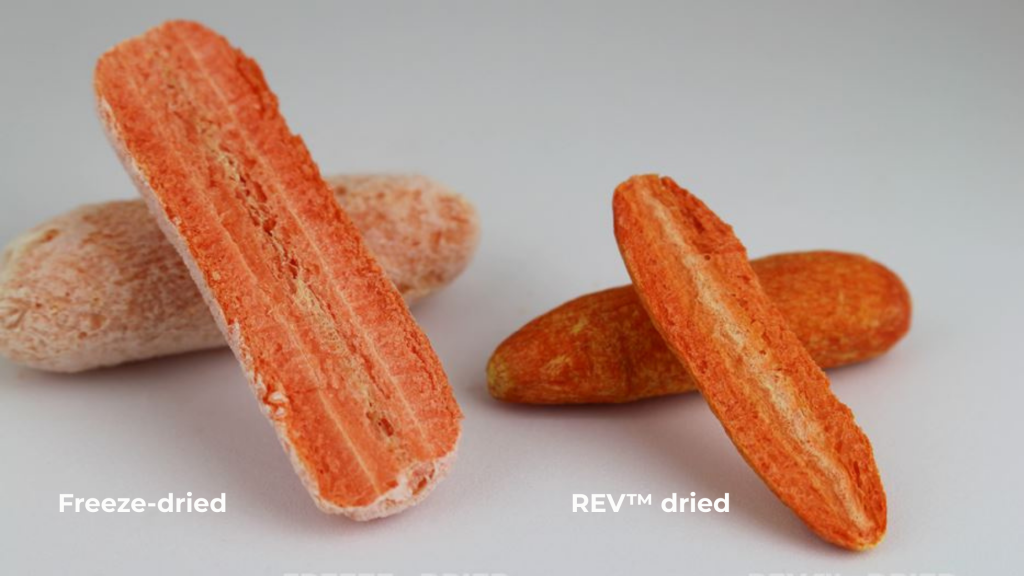
That distinction matters when consistency is the goal. REV offers precise moisture control for crunchy or chewy textures and its consistent, uniform drying helps eliminate case hardening and texture inconsistency. With typical drying cycles of 45 to 60 minutes for many targeted applications, compared with many hours or days for conventional options.
For processors looking at microwave drying equipment, the bigger point is not only speed. It is controllability. If the system lets you tune vacuum, power, dwell time, and end-point targets, you gain a more reliable way to dial in a product spec and repeat it.
What does good moisture control look like in real product development
Good moisture control shows up as stable texture, predictable shelf life, and repeatable numbers from batch to batch. It also means the process can be adjusted for different end goals rather than forcing every product into the same dry-down profile.
A well-controlled system should let you work backward from the desired eating experience and shelf stability target, then set the process to reach it consistently. That is very different from simply running the dryer until the product “looks done.”
How should food processors evaluate scalability and batch consistency
Scalability is not just about buying a larger machine. It is about whether the process still behaves the same way when volume increases. A dryer that performs well for pilot batches but loses moisture uniformity at higher loading levels can slow down commercialization.
EnWave offers a range of equipment from small batch systems for product development to continuous systems for large scale commercial processing. That matters because different product stages need different operating windows, loading patterns, and throughput expectations.
The practical question for buyers is this. Can the supplier show that moisture targets, water activity, and texture outcomes remain stable as throughput grows. If the answer is vague, the equipment may still be useful for trials, but it may not be ready for dependable scale-up production.
What can the UBC study tell us about moisture control and product quality
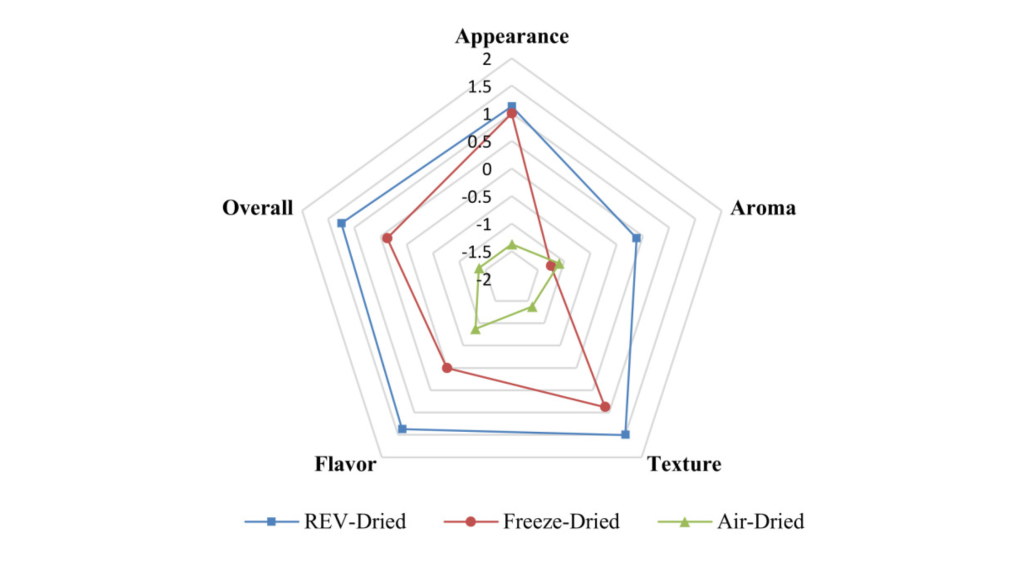
The University of British Columbia study is helpful because it compares REV drying, freeze drying, and air drying across broccoli, oranges, and carrots using the same framework. The paper reports that REV significantly shortened processing time, retained much higher nutritional values than air drying, remained competitive with freeze drying, and earned the highest sensory scores among the methods tested. It also found that moisture content and water activity stayed stable during the accelerated shelf-life study on REV-dried samples.
The results are particularly relevant for teams focused on product development and food innovation. Stable moisture content and water activity after drying support more dependable shelf life. At the same time, better sensory scores suggest that stronger moisture control does not have to come at the expense of taste or texture.
The same study also reminds us that moisture and quality are linked. The paper notes that all methods reduced moisture and water activity to safe points, but product quality still varied significantly by method. That is an important message for processor teams comparing industrial drying systems. Dry enough is not the same as commercially ready.
How does commercial freeze drying fit into this decision
Commercial freeze drying still plays an important role when very low temperatures and strong nutrient retention are required. It remains a familiar benchmark for high quality dried products and ingredients.
At the same time, its limits in speed, energy use, and scale. For food processors, that means freeze drying should be treated as one option, not the default answer for every product.
If your main challenge is moisture uniformity, shorter cycle time, or predictable batch production, it makes sense to compare it against newer drying technology rather than assuming it is automatically the best fit.
What questions should you ask before choosing food processing equipment
Start with the end product, not the machine brochure. Ask what moisture content and water activity your product actually needs, what texture you are targeting, and how much variation your packaging and shelf-life claims can tolerate. This recommendation is based on the process control and quality criteria documented in the sources.
Then ask the equipment supplier for proof points. Request cross-batch consistency data, moisture maps across the tray or product bed, documentation on how temperature and power are controlled, and examples of where the same system has moved from pilot to production. For microwave based systems, it is especially worth asking how they address heating uniformity and end-point control. This guidance aligns with the uniformity and process-control issues raised in the cited research.
If you are working in food tech or innovation led categories, also ask whether the technology helps you create new textures or formats. Moisture control is not only a safety and shelf-life issue. It can be a product design tool when the equipment is precise enough to use it that way.
FAQ
What is the difference between moisture content and water activity
Moisture content is the total amount of water in a product. Water activity is the amount of that water that is available for microbial growth and chemical change. They are related, but they are not the same measurement.
Why is drying uniformity important in industrial dehydration equipment
Drying uniformity matters because uneven moisture leads to inconsistent texture, unstable shelf life, and greater risk of quality loss within the same batch. Better uniformity means more predictable production.
What water activity is considered safer for dehydrated foods
University of Minnesota Extension notes that foods with a water activity of 0.85 or less have a lower risk of bacterial survival and growth when properly prepared and stored. Properly dehydrated fruit can be around 0.60.
Is commercial freeze drying the best choice for every food product
No. Freeze drying is strong in quality retention, but it can be slower, more energy intensive, and more challenging to scale than other drying methods depending on the product and production goal.
What should food processors look for in microwave drying equipment
Look for control over power, pressure, temperature, and final moisture targets. Also ask for evidence of uniform drying, batch repeatability, and scalability from product development through commercial production. This recommendation is based on the documented controls and performance attributes in the sources.
How does moisture control support product innovation
Precise moisture control lets teams tune crunch, chew, density, and shelf stability more intentionally. That makes it easier to develop new snack formats and reduce trial-and-error during scale-up.
Conclusion
Choosing industrial dehydration equipment is not only about drying speed or capital cost. It is about whether the system gives your team enough control to make a product the same way every time. That is what supports stronger commercialization decisions, smoother scale-up, and more dependable quality in market.
For food processors comparing industrial drying systems, moisture control is a smart place to focus. If the equipment can deliver uniform drying, measurable end points, and repeatable batch performance, you are in a much better position to build products that hold up in the real world. And if the system also supports faster drying, scalable production, and more flexibility in texture, it can do more than preserve product. It can help shape product innovation from the start.
Further Reading