

Why Food Innovation Budgets Need Fast, Scalable Drying Technology
R&D budgets are under more pressure to prove value early, which makes drying technology a commercial decision, not just a technical one. REV™ is relevant because it can help food teams move faster from concept to shelf while supporting yield, quality, and efficiency. For product development leaders, that means food processing solutions now need to show a clearer path to revenue, not just technical curiosity.
Why are food innovation budgets under more pressure now?
Food innovation budgets are under more pressure because companies want faster proof that a project will contribute to business results. Exploratory work still matters, but it now has to show a clearer line to efficiency, yield, cost reduction, or revenue much earlier in the process.
That shift is changing how R&D teams operate. A promising idea is no longer enough on its own. Leadership wants to know whether the concept can be manufactured, sold, and scaled without creating more risk than return.
For food manufacturers, that creates a practical challenge. The same team that wants to create something new also has to think about production realities, shelf life, ingredient cost, and time to market. That is why food technology is now being judged not only on novelty, but on commercial usefulness.
Why are companies rethinking commercial freeze drying?
Companies are rethinking commercial freeze drying because it can be strong on preservation but harder to justify in a tighter budget environment. Freeze drying has a place, especially for products that need premium quality retention, but it can also bring longer cycle times and a more difficult economic case at scale. That makes it less appealing for teams that need faster validation and a clearer business outcome.
Food innovation leaders are looking for drying technology that supports more than one goal at once. They want quality, yes, but they also need speed, efficiency, and a more practical path to launch. If a method preserves a product beautifully but slows production or ties up capital, it may not fit today’s R&D reality.
That is where the conversation changes. Instead of asking which process is technically best in isolation, teams are asking which process gives them the best chance of bringing a product to market with less friction. In that context, commercial freeze drying becomes one option among several, not the automatic choice.
What does this mean for food innovation teams?
Food innovation teams now have to think like operators as well as inventors. The best ideas are still welcome, but they have to answer practical questions sooner. Can this product be made efficiently? Can it hold quality at scale? Will it reduce waste or improve margin?
That shift is why product development and food processing are getting closer together. A concept that cannot survive commercial reality will struggle to move beyond the lab. In this environment, technology that supports faster validation has real value.
It also changes how teams prioritize experiments. Instead of chasing only novelty, they need to test whether a product can fit the plant, the budget, and the launch timeline. That makes the choice of drying technology a strategic decision, not a back-end processing detail.
Why is REV™ so relevant right now?
REV™ is relevant because it connects innovation with commercial outcomes. EnWave describes REV as a vacuum microwave dehydration process that dries products rapidly and gently while preserving quality attributes like colour, flavour, and nutrients. That is important when budgets need to justify themselves earlier.
REV also helps shorten the path from idea to market. According to EnWave, the process offers precise moisture control, efficient drying, and a smaller footprint than many other drying methods. For teams under pressure to show a business case, those are not minor technical advantages. They are operational benefits.
The relevance is even clearer when a team is trying to build a new product platform. A process that preserves quality while supporting commercial scale helps teams make decisions with more confidence. That makes REV useful not only as a drying method, but as a development tool.
How does REV support speed to market?
REV supports speed to market by reducing the time needed to dry and test products. Faster drying means faster trials, faster product learning, and faster movement toward launch. That matters when a project has to prove itself before the budget cycle closes.
Speed to market is valuable because product development rarely goes perfectly the first time. Teams often need to adjust formulation, texture, moisture level, or ingredient balance after early testing. A faster process shortens those feedback loops and helps teams learn more quickly.
It also helps reduce the lag between innovation and commercialization. When a team can test, refine, and validate a concept more quickly, it can move on stronger products sooner. That is a big advantage in a market where timing often determines whether a product wins shelf space.
How does REV support yield?
REV supports yield by helping teams dry products in a more controlled way. EnWave says the technology allows precise control over pressure and microwave power density, which helps manage both temperature and final moisture.
That control matters because yield is tied to how much of the original product becomes saleable output. If the process is too harsh, too slow, or too inconsistent, teams can lose product quality and usable volume. Better moisture control can help protect the value of the raw material.
Yield also matters at the business level because waste is expensive. When a process helps turn more input into acceptable finished product, it improves the economics of innovation. That makes the technology easier to defend in a tighter budget setting.
How does REV support quality?
REV supports quality by combining rapid drying with gentle processing conditions. EnWave describes the process as rapid and gentle, with the ability to preserve sensory attributes that matter in food products.
That is important because quality is often what determines whether a product can succeed in the market. Texture, aroma, flavour, and appearance all shape the consumer experience. If those qualities are lost during drying, the product may still be shelf stable, but it may not be compelling.
REV is especially useful for products where quality and differentiation are linked. Fruits, vegetables, snacks, dairy applications, and other sensitive ingredients often benefit from a process that protects more of the original character. That gives food innovation teams more room to create products people actually want to buy again.
What makes microwave drying equipment attractive for today’s budgets?
Microwave drying equipment is attractive because it can improve throughput and reduce processing time. Scientific reviews note that microwave drying uses volumetric heating, which can shorten drying time and improve energy efficiency compared with traditional methods.
This matters because cost-conscious R&D teams are not just buying a dryer. They are buying a way to make innovation more efficient. If a drying method speeds up trials, supports scale-up, and reduces the time to generate commercial evidence, it becomes much easier to defend financially.
It also helps in food processing where cycle time affects labor, inventory, and plant utilization. When a process lets the team move faster without sacrificing product quality, it supports both the technical and commercial sides of the business.
How does REV compare with commercial freeze drying?
Commercial freeze drying is often strong on preservation, but it can be slower and harder to scale economically. EnWave’s materials compare REV favourably on speed and commercial practicality, especially where product quality still needs to be preserved. For some categories, that difference is decisive.
The point is not that freeze drying has no role. It does. The point is that food innovation teams need options that better fit today’s business environment. If the process is too slow or too costly, it can hold back product development even when the concept is promising.
That is why more leaders are comparing commercial freeze drying with alternative drying technology more carefully. The best choice is the one that supports the product and the business model together.
Why does food processing need to be tied to business outcomes?
Food processing needs to be tied to business outcomes because process decisions shape margin, waste, and speed to market. A drying method that preserves quality but takes too long may not survive a leaner budget environment. A method that improves throughput but damages product appeal may fail commercially.
REV is relevant because it sits closer to that middle ground. It can help teams pursue shelf-stable products without forcing them to choose between speed and quality. That balance is useful when innovation has to earn its place.
This is especially important in the current food tech environment. Teams are being asked to demonstrate not just that a product is possible, but that it is practical. Technology that supports that proof can move from nice-to-have to must-have very quickly.
How does REV help with product development?
REV helps product development by making iteration faster and more practical. Food teams can test formulations, textures, and shelf life with a process that behaves more like commercial production than a purely lab-scale experiment. That gives better data for decision making.
It also supports a broader range of products. EnWave highlights applications across fruits, vegetables, meats, dairy, baked goods, and other organic materials. That flexibility matters because product development teams are often looking for platforms, not one-off solutions.
When a team can use one technology across multiple innovation projects, it reduces complexity. It also makes the budget easier to justify because the value is not tied to a single SKU.
What should leaders ask before approving new drying technology?
Leaders should ask whether the technology improves one of four things. Does it reduce time, increase yield, lower cost, or raise revenue? If the answer is no, it may be hard to justify in a tighter budget environment.
A useful checklist is simple.
- Will it shorten development cycles.
- Will it improve product quality at scale.
- Will it reduce waste or rework.
- Will it support launch economics.
- Will it help the team compete faster.
If a drying technology can answer yes to several of those questions, it becomes much easier to defend.
Why does REV fit the current food tech conversation?
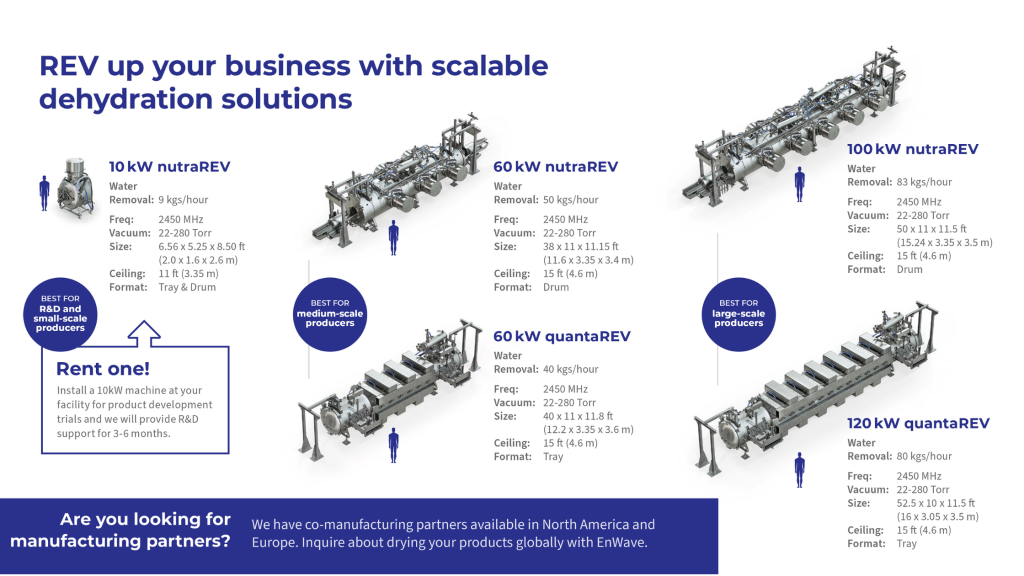
REV fits the current food tech conversation because it is not just about drying. It is about building a more commercial path from idea to product. EnWave frames REV as a scalable, efficient system that helps partners create differentiated products and improve manufacturing performance.
That is the kind of story investors, operators, and R&D leaders can all understand. It shows that food innovation does not have to slow down. It just has to be more disciplined about how it spends.
For brands that want to keep innovating without overextending budgets, that balance matters. A drying process that supports both creativity and efficiency has a stronger chance of staying in the strategy.
Conclusion
R&D budgets have become more selective, but that does not mean innovation has stopped. It means the commercial case has to be clearer, earlier, and stronger. In that setting, REV matters because it helps food teams connect product development with efficiency, yield, cost reduction, and revenue.
For companies comparing commercial freeze drying, food dehydration, and other drying technology options, REV offers a practical middle path. It is fast, flexible, and built for commercial food processing realities. That is exactly the kind of solution current budgets are more likely to support.
FAQ
Why is REV useful when budgets are tight?
It shortens development timelines and supports a clearer commercial case, which makes it easier to justify spending.
Is REV only useful for snack products?
No. EnWave notes applications across many food categories, including fruits, vegetables, meats, dairy, and baked goods.
How does REV compare with commercial freeze drying?
REV can be faster and more commercially efficient while still preserving important product qualities.
Does microwave drying equipment help with scale-up?
Yes. Microwave drying can improve throughput and reduce drying time, which supports scale-up and production efficiency.
Why is food processing under more pressure now?
Because innovation spend needs to show a business impact earlier, especially around efficiency, yield, cost, or revenue.
What makes REV relevant for product development leaders?
It helps them move from concept to commercial reality with less time, less risk, and more control over product quality.
Further reading
EnWave Commercial drying solutions that fuel innovation
EnWave How does EnWave’s REV technology work? Common questions explained
EnWave How is microwave dehydration changing the food industry?
EnWave Freeze Drying vs Microwave Drying
Comparison of Traditional and Novel Drying Techniques and Its Application in Foods
https://pmc.ncbi.nlm.nih.gov/articles/PMC7554907
Microwave Drying overview
https://www.sciencedirect.com/topics/agricultural-and-biological-sciences/microwave-drying
Role of Food Microwave Drying in Hybrid Drying Technology