

Does Freeze Drying remove nutrients?

Freeze drying retains 90–97% of most nutrients in food especially vitamins, minerals, and antioxidants making it one of the best traditional methods for preservation. The process works at low temperatures under vacuum, so nutrient losses are far lower than with heat-based drying. However, some sensitive nutrients, especially vitamin C, can see modest losses of 5–10% during typical cycles.

Key Takeaways
- Freeze drying preserves proteins, minerals, and most vitamins effectively, typically 90–97% retention.
- Microwave vacuum drying (EnWave’s REV™) matches these nutrient retention rates, while drying 25–28 times faster with substantially lower energy use.
- Both methods far outperform hot air drying, which can lose 40–60% or more of heat-sensitive nutrients.
- Modern food processors choose technologies based on speed, cost, and scalability as well as nutrient preservation.
Quick Overview
Freeze drying sets a high bar for nutrient preservation, but it typically requires 24–48 hours and significant energy input. EnWave’s microwave vacuum drying (REV™) delivers comparable product quality in 10–60 minutes, using much less energy and lowering cost per unit processed. This blog summarizes the science, compares methods, and answers common questions to help guide food innovation and commercial-scale decisions.
How Does Freeze Drying Preserve Nutrients?
Freeze drying freezes food, then removes water by sublimation under vacuum, holding product temperature well below -40°C. This minimizes heat-induced nutrient losses compared to traditional hot air or oven drying, which use higher temperatures.
Cellular structure remains mostly intact, trapping nutrients inside. Fruit studies show 90–97% retention for many vitamins compared to fresh equivalents.
The vacuum also limits oxygen exposure, keeping antioxidants more stable than air drying methods.
Which Nutrients Stay Intact During Freeze Drying?
Proteins are nearly 100% preserved thanks to the cold, oxygen-free process. Minerals like iron, calcium, and potassium maintain 98–100% retention.
Most B vitamins remain above 90–95%. Fat-soluble vitamins (A, E) are well retained with minimal oxidation.
Only heat- and oxidation-sensitive compounds, generally vitamin C and some polyphenols, experience minor drops. Freeze-dried food is nutritionally close to fresh.
Which Nutrients Show Losses in Freeze Drying?
Vitamin C typically drops 5–10% due to mild oxidation and extended sublimation cycles. Some polyphenols and antioxidants in berries may also degrade slightly, especially over longer cycles.
Losses remain much lower than in hot air drying, which may destroy over 50% of these nutrients. Denser foods can fare best due to reduced exposure.
What Causes Any Nutrient Loss in Freeze Drying?
Oxidation during extended drying, particularly during the secondary drying phase, is the main cause. Long process times can amplify this effect.
Freeze–thaw cycles may also stress cellular structure in high-moisture fruits. Optimized protocols keep losses under 10%.
How Does Freeze Drying Compare Nutritionally to Hot Air Drying?
Freeze drying retains 90%+ of vitamins across most categories. Hot air at 50–70°C destroys vitamin C and B vitamins at rates of 40–60%.
Protein retention is higher in freeze drying. Hot air is chosen for low-cost bulk but has a much greater nutritional penalty.
How Does Freeze Drying Stack Up Against Spray Drying?
Spray drying uses high heat (150–200°C), which rapidly destroys heat-sensitive vitamins (often 70%+ loss). Freeze drying preserves structure for better rehydration and is suitable for solids; spray drying is for liquids and extracts.
Where Does Microwave Vacuum Drying Fit Nutritionally?
Microwave vacuum drying uses low temperatures (usually 30–50°C) under vacuum to evaporate water throughout the product volumetrically. It matches freeze drying’s 90–97% nutrient retention, but does this in minutes, not hours or days.
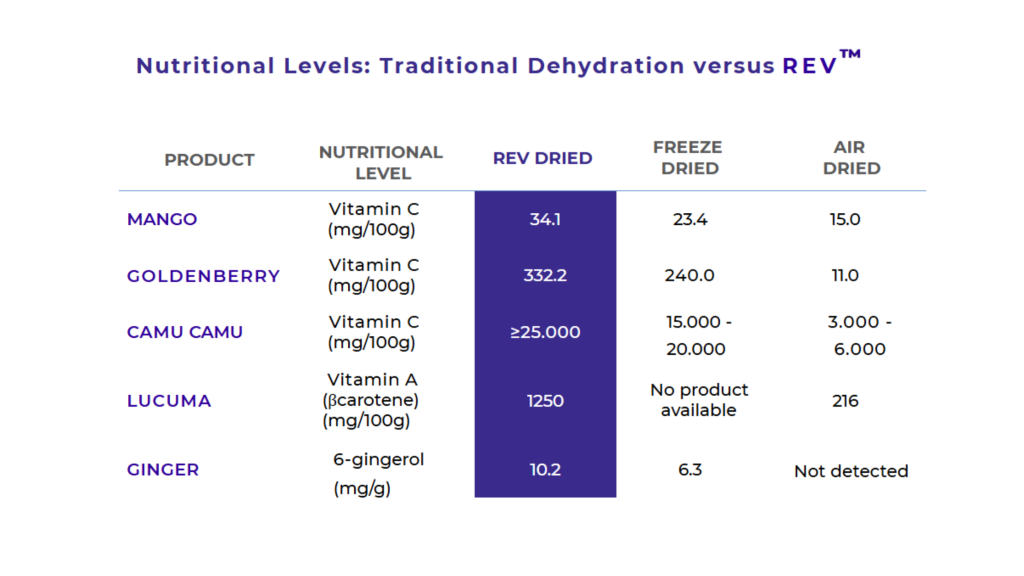
Shorter exposure reduces oxidation risk. EnWave’s REV™ has been validated on various food categories for nutrient and sensory retention, see examples below.
Does Microwave Vacuum Drying Retain Nutrients Like Freeze Drying?
Yes; studies show 90–97% vitamin retention, often matching or exceeding freeze drying for color-sensitive compounds (e.g., vitamin C and carotenoids in produce). Proteins and minerals remain intact. The vacuum further protects against oxidation.
Why Does Microwave Drying Preserve Nutrients Despite Speed?
Microwaves target water molecules for rapid internal heating. The vacuum drops the boiling point, allowing for gentle, uniform drying and very short process times, minimizing any heat or oxidation-related losses.
How Does Processing Time Affect Nutrient Retention?
Longer times lead to greater oxidation risk. Freeze drying’s days-long batch times incur minor but real losses. Microwave vacuum completes in 10–60 minutes, yielding fresher-tasting, more stable products with preserved nutrition.
What Real Foods Show Best Nutrient Retention in Microwave Vacuum?
Berries retain 95%+ of antioxidants, meats retain full protein profiles, and vegetable powders retain vitamin content near fresh. These results are supported by lab analysis.
What Are the Practical Limits of Freeze Drying?
Long batch times create delays, and energy demands are much higher (measured at up to 50% greater than alternatives). Scaling for commercial throughput is challenging and expensive.
How Does Energy Consumption Compare Across Methods?
Freeze drying requires constant low temperatures and vacuum pumps for long durations. Microwave vacuum is proven to use 70–90% less energy for equivalent water removal, thanks to rapid, targeted energy input.
| Aspect | Freeze Drying | Air Drying | Microwave Vacuum |
|---|---|---|---|
| Time | 24–48 hours | 10 –18 hours | 2-3 hours |
| Energy Use | Alta | Moderate | 70–90% lower |
| Scalability | Limited | Good | Excellent |
Can Microwave Vacuum Handle Heat-Sensitive Foods?
Yes. Delicate items like berries, herbs, and leafy greens dry with full color, flavor, and structure preserved.
How Versatile Is Microwave Vacuum for Product Types?
REV™ suits fruits, meats, vegetables, and powders. Textures can be tailored for jerky, crisps, or powders. The technology readily scales from pilot to commercial.
How Does EnWave Test and Verify Nutrient Retention?
EnWave and its collaborators use HPLC and antioxidant assays to compare nutrients before and after drying. Protocols are optimized for each product, helping substantiate clean-label claims.
Why Do Food Innovators Switch from Commercial Freeze Drying?
Microwave vacuum offers faster prototyping, lower costs, and consistent scale-up while matching nutrition and quality benchmarks.
What Role Does Drying Play in Clean-Label Trends?
Minimal processing with full nutrition aligns with consumer demand and labeling standards. Microwave vacuum drying enables additive-free, functional snacks and ingredients.
How Does Drying Tech Speed Product Development?
Faster cycles enable rapid prototyping, quick flavor testing, and reduced time to market.
Is Freeze-Dried Food Truly as Nutritious as Fresh?
Both freeze- and microwave-vacuum-dried foods retain 90–97% of key nutrients (after rehydration), far exceeding thermally processed foods and canned goods.
Does Microwave Dehydration Destroy Vitamins?
No. Studies confirm 90%+ retention for vitamin C and other sensitive nutrients in properly designed cycles.
Which Method Best Preserves Antioxidants?
Freeze drying and microwave vacuum both yield 85–95% antioxidant retention; microwave has the edge with faster cycles for highly oxidation-prone products.
How Long Do Nutrients Survive in Dried Products?
With proper storage (low moisture, airtight, and cool), nutrients remain viable for years.
Can Home Users Match Commercial Nutrient Retention?
Home freeze dryers can approach commercial results but lack full control. Commercial microwave vacuum offers laboratory-grade precision.
What Equipment Fits Small-Scale Food Drying?
EnWave’s pilot-scale systems allow small- to mid-size processing and are scalable without major retooling.
How to Transition from Freeze Drying Equipment?
Run direct side-by-side tests on nutrition and quality. Pilot REV™ systems enable a smooth shift.
Freeze drying set the gold standard for nutrition. Microwave vacuum drying meets it while solving key speed, cost, and scalability challenges for modern product development and food innovation.
Frequently Asked Questions
Does freeze drying destroy nutrients?
No, it preserves 90-97% effectively across vitamins and proteins. Losses stay minimal.
Is microwave-dried food healthy?
Yes, matches freeze drying nutrition with rapid processing for stability.
Which drying method keeps most nutrients?
Freeze drying and microwave vacuum both hit 90-97%. Microwave adds speed.
Does drying affect protein quality?
Minimal impact. 95-100% retention in quality methods.
How much vitamin C survives drying?
90-97% in freeze and microwave vacuum. Far better than heat methods.
Is commercial freeze drying worth the cost?
For niche textures yes. Microwave offers same nutrition cheaper and faster.
Last Notes:
- Both methods preserve nutrients exceptionally well, especially compared to heat-based drying.
- Microwave vacuum drying stands out for production speed and energy savings, with no loss in nutritional value.
Further Reading
EnWave, Freeze Drying vs Microwave Drying:
https://www.enwave.net/freeze-drying-vs-microwave-drying/enwave
EnWave, Myths Around Microwave Drying:
https://www.enwave.net/breaking-down-the-myths-around-microwave-drying-technology
Green Thumb Depot, Does Freeze Drying Remove Nutrients:
https://greenthumbdepot.com/blogs/guides/does-freeze-drying-remove-nutrientsgreenthumbdepot
ScienceDirect, Vacuum Microwave Drying Characterization:
https://www.sciencedirect.com/science/article/abs/pii/S0963996998000702sciencedirect
RSC Publishing, Vacuum Microwave Pretreatment Quality:
https://pubs.rsc.org/en/content/articlehtml/2025/fb/d5fb00108kpubs.rsc