
How to Dry Food Without Preservatives
Preservative-free dried snacks are growing in popularity because consumers want simpler ingredient lists, minimally processed foods, and products they can feel good about eating. The challenge is that removing preservatives does not remove the need for shelf stability.
The good news is that food can often be preserved without artificial preservatives when moisture is carefully controlled. This is why food dehydration has become one of the most important technologies in modern food processing.
In this guide, we’ll explore how preservative-free dried snacks are made, the role drying technology plays in food preservation, common challenges manufacturers face, and how newer approaches to commercial food drying are creating opportunities for product innovation.
What Does “Preservative-Free Dried Snacks” Mean?
Preservative-free dried snacks are products that achieve shelf stability through moisture reduction rather than relying on artificial preservatives.
When water is removed from food, the environment becomes less favorable for microbial growth. For centuries, drying has been used as one of the most effective methods of food preservation.
Today, consumers are increasingly looking for snacks made from recognizable ingredients with shorter ingredient lists. This has contributed to growing interest in dried fruits, vegetable snacks, protein snacks, dairy snacks, pet treats, and functional ingredients that contain no added preservatives.
Examples include:
- Dried fruit snacks
- Vegetable crisps
- Cheese snacks
- Meat snacks
- Seafood snacks
- Functional ingredient inclusions
- Pet treats
The appeal is simple. Consumers want convenience without compromising ingredient transparency.
How Does Drying Food Help Preserve It Naturally?
Drying food preserves it by reducing moisture content and lowering water activity.
Microorganisms such as bacteria, yeasts, and molds require available water to grow. When moisture levels are reduced to appropriate levels, shelf life can increase significantly.
This principle is the foundation of many food dehydration methods used throughout the food industry.
The goal is not simply to make food dry. The goal is to remove enough moisture while maintaining quality, flavor, nutrition, texture, and appearance.
That is where drying technology becomes important.
Why Are Preservative-Free Snacks Becoming More Popular?
Consumers are paying closer attention to ingredient labels than ever before.
Many shoppers actively seek products with:
- Short ingredient lists
- Clean label positioning
- Minimal processing
- Natural ingredients
- Transparent sourcing
- Functional nutrition
These preferences are influencing nearly every food category, including snacks, ingredients, nutraceuticals, and pet food.
As a result, manufacturers are looking for ways to create shelf-stable products without relying on artificial preservatives whenever possible.
This trend is driving significant interest in advanced food processing technologies that help retain quality while supporting cleaner labels.
What Challenges Are Associated With Preservative-Free Food Products?
Creating preservative-free dried snacks is not as simple as removing ingredients from a formulation.
Manufacturers must balance several competing priorities.
These include:
- Product safety
- Shelf stability
- Taste
- Textura
- Color
- Nutrition
- Production costs
- Commercial scalability
For example, excessive heat may damage sensitive ingredients or affect flavor and color. Insufficient drying may reduce shelf life. Aggressive processing can also negatively impact texture.
Finding the right balance often becomes a product development challenge.
This is why drying technology has become a major area of innovation in food manufacturing.
What Are the Most Common Methods Used for Food Dehydration?
Several food dehydration methods are used commercially.
Each offers different advantages depending on the product and production requirements.
Air Drying
Air drying removes moisture through exposure to heated air.
This is one of the oldest and most widely used drying methods.
Benefits may include:
- Established process
- Broad adoption
- Relatively simple operation
Potential considerations include:
- Longer drying times
- Heat exposure
- Product shrinkage
- Variable texture outcomes
Commercial Freeze Drying
Commercial freeze drying removes water through sublimation under vacuum conditions.
This method is often associated with premium products because it can help maintain product structure and quality.
Benefits may include:
- Excellent product preservation
- Strong consumer perception
- High-quality finished products
Potential considerations include:
- Long processing cycles
- Higher equipment costs
- High energy requirements
Vacuum Microwave Drying
Vacuum microwave drying combines vacuum conditions with microwave energy.
Scientific reviews have described vacuum microwave drying as an efficient dehydration process that can help maintain food quality while reducing drying times compared to some traditional methods.
Benefits reported in academic literature include:
- Reduced drying times
- Low-temperature processing capabilities
- Improved texture characteristics
- High-quality finished products
- Efficient moisture removal
This has made vacuum microwave drying an area of growing interest within food tech and product innovation.
What Is the Best Drying Method for Preservative-Free Snacks?
There is no single best drying method for every product.
The right solution depends on:
- Product type
- Desired texture
- Shelf-life objectives
- Production volume
- Cost targets
- Nutritional goals
For some applications, traditional drying may be appropriate.
For others, manufacturers may require greater control over texture, moisture, or processing conditions.
This is why many companies evaluate multiple drying technologies during product development.
The most successful projects often begin by defining the desired consumer experience and then selecting the processing method that best supports that outcome.
Why Is Texture So Important in Product Innovation?
Texture is often one of the biggest drivers of product differentiation.
Consumers rarely describe a snack simply by its ingredients. They often describe the eating experience.
Examples include:
- Crunchy
- Crispy
- Light
- Puffed
- Chewy
- Tender
These sensory attributes strongly influence consumer perception of quality.
For food innovators, texture becomes an important tool for creating unique products that stand apart in competitive markets.
The drying process plays a major role in determining those final characteristics.
How Does Microwave Dehydration Support Product Development?
Microwave dehydration can provide manufacturers with additional flexibility when developing new products.
By combining microwave energy with vacuum conditions, vacuum microwave drying systems are designed to remove moisture efficiently while helping maintain product quality.
At EnWave, our patented REV™ technology uses vacuum microwave dehydration to help food manufacturers create innovative shelf-stable products across a wide range of categories.
Depending on the application, REV™ technology can support the development of different textures and product formats, creating opportunities for differentiation and product innovation.
This flexibility is particularly valuable for companies exploring:
- Premium snacks
- Functional ingredients
- Nutraceutical products
- Pet treats
- Dairy snacks
- Fruit and vegetable products
What Types of Foods Can Be Dried Without Preservatives?
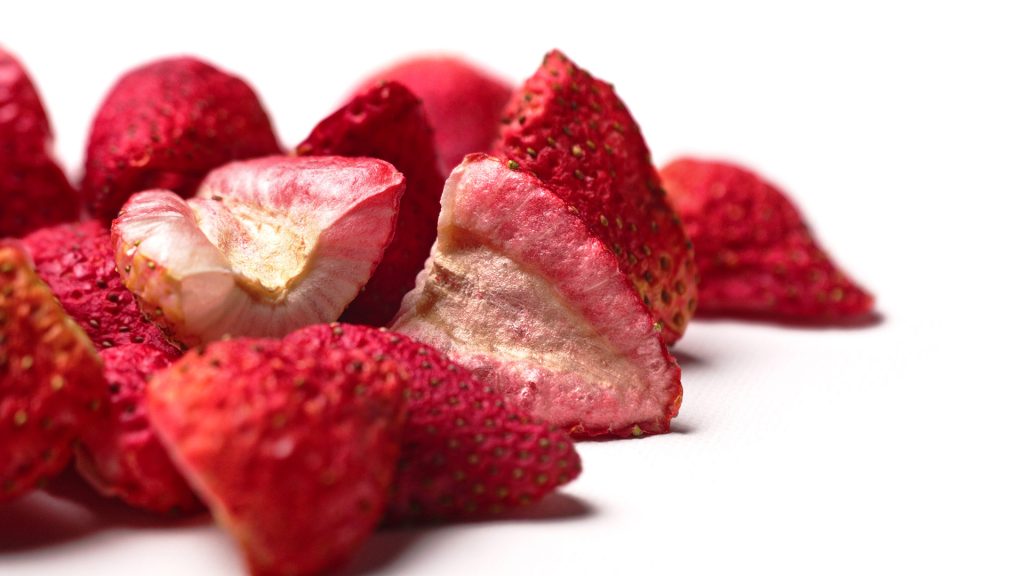
Many foods can be dried without artificial preservatives when moisture is properly managed.
Examples include:
Fruits
- Strawberries
- Blueberries
- Mangoes
- Apples
- Pineapple
Vegetables
- Carrots
- Sweet potatoes
- Peppers
- Tomatoes
Protein Products
- Chicken
- Beef
- Seafood
- Cheese
- Yogurt-based ingredients
Functional Ingredients
- Plant-based ingredients
- Nutraceutical formulations
- Botanical ingredients
- Specialty food inclusions
Success ultimately depends on product formulation, processing conditions, target moisture levels, packaging, and storage requirements.
What Role Does Packaging Play in Preservative-Free Foods?
Even the best drying process can be compromised by poor packaging.
After drying, products must be protected from moisture exposure.
Packaging can help preserve:
- Textura
- Shelf stability
- Product quality
- Aroma
- Freshness
Many food companies combine advanced drying processes with carefully selected packaging solutions to maintain the desired consumer experience.
For preservative-free products, drying and packaging work together.
Neither should be considered in isolation.
How Can Manufacturers Create Premium Dried Snacks?
Premium dried snacks are typically created through a combination of ingredients, formulation, processing, and branding.
Some best practices include:
Start With High-Quality Ingredients
The finished product can only be as good as the starting material.
Design Around Consumer Experience
Consider texture, aroma, appearance, and eating experience early in development.
Evaluate Different Drying Technologies
Different technologies can lead to significantly different outcomes.
Prioritize Shelf Stability
Product quality must remain consistent throughout its intended shelf life.
Test Commercial Scalability
Successful product innovation requires solutions that can grow beyond pilot production.
What Does the Future of Preservative-Free Dried Snacks Look Like?
Consumer demand for clean label foods continues to grow.
At the same time, food manufacturers are under pressure to differentiate products while maintaining quality and operational efficiency.
This combination is encouraging greater investment in:
- Food innovation
- Advanced drying technology
- Commercial food drying systems
- Product development
- Functional ingredients
- Premium snack formats
As the industry evolves, drying technology will likely continue playing an important role in helping manufacturers create products with fewer additives while delivering the quality consumers expect.
FAQ
Can food be preserved without artificial preservatives?
Yes. Drying is one of the oldest food preservation methods and can help extend shelf life by reducing moisture content and available water.
What is food dehydration?
Food dehydration is the process of removing moisture from food to improve shelf stability and preservation.
What is vacuum microwave drying?
Vacuum microwave drying combines microwave energy and vacuum conditions to remove moisture efficiently while supporting product quality. Scientific literature describes it as an effective food dehydration technology with applications across many food categories.
Is freeze drying the only way to make preservative-free snacks?
No. Freeze drying is one method, but air drying, vacuum microwave drying, and other commercial food drying technologies are also used depending on product requirements.
Why does drying technology matter for product innovation?
Drying technology can influence texture, appearance, shelf stability, moisture content, and overall product quality.
What products can be made using vacuum microwave dehydration?
Vacuum microwave dehydration has applications across fruits, vegetables, proteins, dairy products, ingredients, nutraceuticals, and pet food products.
Final Thoughts
Creating preservative-free dried snacks requires much more than removing additives from a formula. The foundation of success lies in controlling moisture while preserving the characteristics consumers care about most.
As demand for cleaner labels, premium products, and innovative snack formats continues to grow, manufacturers are increasingly exploring new approaches to food dehydration and product development.
Whether companies are evaluating commercial freeze drying, conventional drying systems, or advanced microwave dehydration technologies, the goal remains the same. Deliver safe, shelf-stable products that offer outstanding quality and a memorable eating experience.
For food innovators looking to develop the next generation of preservative-free snacks, drying technology is no longer just a manufacturing decision. It has become a strategic tool for product innovation.
Further Reading
- Innova Market Insights
- Institute of Food Technologists Food Processing Toolkit [ift.org]
- Vacuum Microwave Drying Technology for Foods (Springer) [link.springer.com]
- Advances in Vacuum Microwave Drying Systems for Food Products [repositori…ubiobio.cl], [scispace.com]
- Overall Quality of Fruits and Vegetables Products Affected by Vacuum Microwave Drying (MDPI) [mdpi.com]
- The REV Technology from EnWave (Anuga FoodTec) [anugafoodtec.com]