

Why is pet food a stronger launch pad for biotech ingredients?
Pet food is becoming one of the fastest routes for biotech ingredients to reach market because consumers are more open to premium claims, sustainability stories, and functional benefits. That makes it a strong category for biotech pet food innovation, especially when brands need shelf-stable formats and reliable scale-up. For EnWave, the key role is in drying technology for pet food, since drying turns fragile biotech ingredients into manufacturable products with the shelf life and texture the market expects.
Pet food as the biotech proving ground
Pet food is often a faster commercialization lane than human food because the consumer decision is different. Pet owners are willing to try novel proteins for pet food, sustainable pet food ingredients, and functional claims if they believe the product is safe, nutritious, and good for their animal. That gives biotech brands more room to test new ingredients before moving into more regulated or more skeptical human categories.
The category also rewards premium positioning. Buyers are often looking for products that feel advanced, ethical, or tailored to their pet’s needs, which creates a natural fit for food tech innovation. That is why pet food scale-up is increasingly tied to biotech, sustainability, and format innovation rather than just cost.
What Makes Biotech Pet Food Innovation Different?
Biotech pet food innovation is different because it combines ingredient science with processing reality. A novel protein or fungi-based ingredient may be promising in the lab, but it still has to survive commercial food dehydration, packaging, shipping, and shelf time. If the product cannot hold up through those steps, it never becomes a real business.
This is where product development becomes practical. Teams need more than a new ingredient idea. They need a way to stabilize it, preserve nutrients, and create a format that works in manufacturing. That is why drying technology for pet food is part of the innovation story, not just the finishing step.
Why Does Drying Matter So Much for Biotech Ingredients?
Drying matters because it turns fragile ingredients into shelf-stable pet food. Many biotech ingredients are sensitive to heat, moisture, oxidation, or texture collapse, which means the drying step can either protect or damage the value of the ingredient. For pet food companies, that makes drying one of the most important decisions in product development.
Good drying can help with several things at once.
- Stabilize alternative proteins for pet food.
- Preserve nutrients in functional ingredients.
- Support shelf-stable pet food formats.
- Improve handling during packaging and shipping.
- Create a more consistent final texture.
If the process is too harsh, the ingredient may still be technically usable, but the product loses quality. That is where a better drying method becomes a competitive advantage.
Why Are Novel Proteins So Important in Pet Food?
Novel proteins are important because they give brands a way to build more sustainable and differentiated products. Consumers are increasingly interested in ingredients that are lower-impact and more novel than conventional meat-based formulas. In pet food, that opens the door to biotech-derived protein systems, fungi-based proteins, and other sustainable pet food ingredients.
These ingredients can be useful in kibble, treats, training snacks, toppers, and functional pet products. They also support the broader trend toward product innovation in pet food, where brands are not just trying to feed pets but also tell a stronger story around ethics, nutrition, and sourcing. The challenge is making those ingredients manufacturable at scale.
How Does REV™ Help Turn Biotech Ingredients Into Products?
REV™ helps by drying ingredients quickly and gently using vacuum microwave dehydration. EnWave explains that the process combines vacuum and microwave energy to manage temperature and final moisture, which helps create shelf-stable products in a controlled way. That is exactly the kind of process biotech ingredients often need.
For pet food, this matters because the final product has to be stable, safe, and commercially viable. REV™ can support that transition by helping preserve functional quality while reducing the drying bottleneck. In practice, that means faster stabilization and a better path from lab concept to production.
What Types of Biotech Ingredients Fit Pet Food Best?
Several ingredient types are especially relevant. These include alternative proteins, fungi-based ingredients, fruit and vegetable inclusions, and functional ingredients built for digestive or nutritional support. Each one can add value, but each one also has different processing needs.
Examples include:
- Alternative proteins for pet food that need gentle stabilization.
- Fungi-based ingredients that support sustainability and protein diversity.
- Fruit and vegetable inclusions that add colour, texture, or functional value.
- Pet treats with biotech-derived functional ingredients.
- Shelf-stable pet food ingredients designed for premium positioning.
The common thread is that all of them need processing support to become real products. That is where food dehydration and shelf-stable product design come together.
Why Is Pet Food Often More Open to Innovation Than Human Food?
Pet food is often more open to innovation because buyers focus more on benefit, trust, and sustainability than on habit. Human consumers can be more cautious about biotech ingredients, especially when claims sound unfamiliar. Pet owners are still selective, but they are often more willing to try a new formula if it feels safe and credible.
That difference gives pet food companies more flexibility. It creates room for biotech ingredients that might be harder to launch in human food first. In that sense, pet food can serve as a proving ground for both ingredient science and processing technology.
How Does Drying Support Shelf-Stable Pet Food?
Drying supports shelf-stable pet food by lowering moisture enough to reduce spoilage risk and improve handling. It also helps retain the sensory qualities that matter in treats and inclusions. Without that stability, even a strong ingredient story can fail in distribution.
This is one reason commercial food dehydration is so important in pet food biotech. The ingredient might be novel, but the manufacturing requirements are still real. Drying turns a promising biotech input into something that can sit on a shelf, survive transport, and stay appealing to the customer.
What Role Does Food Tech Play in Pet Food Scale-Up?
Food tech plays a major role because scale-up is where many biotech products get stuck. A concept can look strong in small batches and still fail when production volume increases. That is especially true when the ingredient is fragile or the texture is hard to control.
REV™ helps solve that by offering a commercial platform designed for repeatable drying. For pet food scale-up, that can reduce the distance between pilot work and launch. It also helps brands protect the qualities that made the ingredient interesting in the first place.
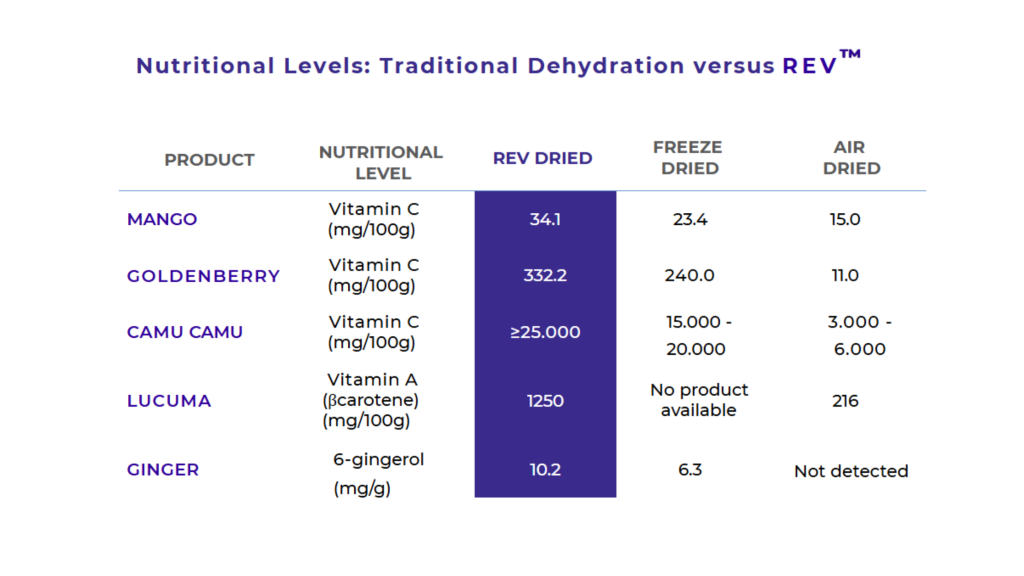
How Does REV™ Compare With Commercial Freeze Drying?
Commercial freeze drying is strong for preservation, but it can be slower and less efficient for scaling certain pet food products. That matters when a biotech ingredient needs to move quickly from test batches into commercial food dehydration. For many pet food developers, speed and repeatability are just as important as ultimate preservation.
REV™ offers a different balance. It uses vacuum microwave dehydration to dry quickly while still preserving quality, which can be a strong fit for high-value ingredients and shelf-stable treats. That makes it an appealing option when the product needs both premium performance and practical throughput.
What Should Product Teams Ask Before Choosing a Drying Method?
Product teams should ask what problem the drying method needs to solve. Is the goal to preserve nutrients, stabilize a fragile ingredient, speed up production, or create a better final texture. Once that is clear, the right drying technology becomes easier to identify.
A simple checklist can help.
- Does the process protect the ingredient’s function.
- Does it support shelf-stable pet food.
- Can it scale from pilot to production.
- Does it fit the brand’s sustainability story.
- Will it help the product stand out in a crowded category.
These questions matter because pet food product development is not just about ingredient sourcing. It is about turning that ingredient into a product that can actually succeed in the market.
Conclusion
Pet food is one of the best proving grounds for biotech because consumers are open to novelty, premium claims, and sustainability stories. But scaling biotech still depends on solving the processing bottleneck. That is why drying technology for pet food is so important, and why REV™ is relevant as a way to stabilize novel proteins, functional ingredients, and shelf-stable formats quickly and gently.
For pet food biotech, the ingredient is only the start. The drying step is what turns it into a product.
FAQ
What is pet food biotech?
Pet food biotech refers to the use of biotech-derived ingredients such as novel proteins, fungi-based inputs, and functional compounds in pet food formulations.
Why is pet food a good category for biotech innovation?
It is often more open to premium claims, sustainability, and novel ingredients than human food.
What is drying technology for pet food?
It is the process used to stabilize pet food ingredients and products by removing moisture so they become shelf-stable and manufacturable.
Why is shelf stability important in pet food biotech?
Biotech ingredients are often fragile, so drying helps preserve quality and make the ingredient usable at commercial scale.
How does REV™ help with pet food scale-up?
REV™ uses vacuum microwave dehydration to dry quickly and gently, which helps preserve nutrients and support commercial food dehydration.
Is freeze drying still useful for pet food?
Yes, but it can be slower and less efficient than other methods when speed and scale are priorities.
Further reading
Forward Fooding Pet food biotech
EnWave What is REV
EnWave How is microwave dehydration changing the food industry
EnWave Popular food drying processes explained
PMC Comparison of traditional and novel drying techniques
https://pmc.ncbi.nlm.nih.gov/articles/PMC7554907
ScienceDirect Microwave Drying
https://www.sciencedirect.com/topics/agricultural-and-biological-sciences/microwave-drying