

How Does Vacuum Microwave Dehydration Work?
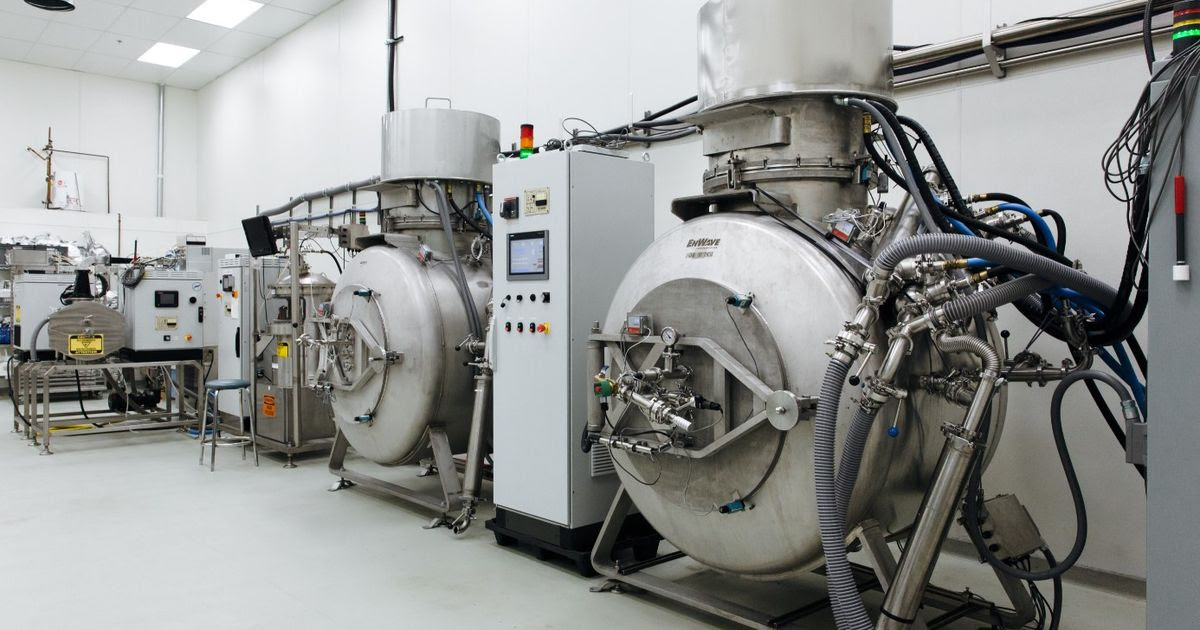
Vacuum microwave dehydration works by combining reduced pressure with microwave energy to remove moisture quickly and at controlled product temperatures. The process is not simply about applying more microwave power. Quality depends on controlling pressure, microwave power density, product loading, thickness, drying time, final moisture, water activity, and packaging as one connected system.
For food manufacturers, this makes vacuum microwave dehydration technology a process-control tool as much as a drying method. The goal is to reach the required moisture and water activity while preserving the intended color, flavor, structure, and nutritional quality.
What is vacuum microwave dehydration?
Vacuum microwave dehydration is a food dehydration process that uses vacuum pressure and microwave energy together. Vacuum lowers the boiling point of water, while microwave energy heats moisture within the product and supports rapid evaporation.
This differs from hot-air drying, which transfers heat from the surface inward, and from freeze drying, which freezes the product before removing ice through sublimation. Vacuum microwave drying uses volumetric heating, meaning microwave energy can generate heat within the material rather than relying only on heat moving inward from the surface.
The exact result depends on the product and the operating conditions. Ingredients with different moisture levels, shapes, thicknesses, compositions, and structures will respond differently.
How does vacuum pressure affect the process?
Vacuum pressure affects the boiling point of water, evaporation conditions, and the movement of vapor out of the product. Lower pressure allows water to evaporate at a lower temperature, which can support low temperature dehydration and reduce prolonged heat exposure.
Pressure also affects mass transfer. If the vacuum level is not appropriate for the product, moisture may not leave uniformly or the structure may respond in an undesirable way. That is why pressure should be treated as a controllable drying parameter rather than a fixed setting.
In a commercial process, manufacturers may evaluate pressure alongside product temperature, moisture removal rate, texture, color, and water activity. The most suitable pressure is the one that supports the target product outcome.
How does microwave power density affect drying?
Microwave power density affects heating rate, moisture movement, and drying speed. Higher power can accelerate moisture removal, but excessive power may create uneven heating, localized overheating, structural damage, or unwanted texture changes.
The objective is not to use the highest possible power. It is to use enough energy to remove moisture efficiently while preserving the product’s quality attributes.
Research on vacuum microwave drying shows that moderate power levels can provide a better balance between drying kinetics and preservation of structure and bioactive compounds for some products. However, the appropriate range depends on the raw material, product geometry, loading, and desired endpoint.
How does product thickness influence drying?
Product thickness influences the distance moisture must travel before it exits the product. Thicker pieces may require more time for internal moisture to move outward, while thin pieces may dry more quickly and develop a different texture.
Thickness can affect:
- Drying uniformity.
- Final moisture.
- Internal structure.
- Crispness or chewiness.
- Rehydration behavior.
- Total cycle time.
A process that works for thin fruit slices may not work for a thick dairy piece or a dense meat product. Product development teams should therefore validate the intended commercial geometry rather than relying only on trials with a different shape.
Why does product loading matter?
Product loading matters because it influences how microwave energy is distributed and how easily vapor can escape. Overloading a tray or placing pieces too close together may create areas with different drying behavior.
Loading pattern can affect:
- Energy distribution.
- Product-to-product uniformity.
- Vapor pathways.
- Batch capacity.
- Heat transfer and moisture removal.
- Repeatability between runs.
For scalable food processing, a loading pattern must be defined and repeatable. A strong pilot result may not translate to commercial production if the production load changes the way energy and moisture move through the system.
How does drying time affect quality?
Drying time affects final moisture, water activity, texture, and heat exposure. Too little time can leave the product unstable or too soft. Too much time can make it brittle, darkened, over-dried, or less flavorful.
Time should not be treated as a universal recipe. The right endpoint depends on the target moisture and water activity, not simply on the number of minutes in the dryer.
A practical process may monitor:
- Product temperature.
- Moisture loss.
- Vacuum behavior.
- Microwave power response.
- Final moisture content.
- Water activity.
- Sensory and structural changes.
This helps the manufacturer stop the process when the product reaches its intended endpoint.
What is the relationship between moisture content and water activity?
Moisture content measures how much water is present in the product. Water activity measures how much of that water is available to support microbial growth and chemical reactions. The two measurements are related, but they are not interchangeable.
Water activity is especially important for shelf-stable food development. A product may have a certain moisture percentage but still behave differently depending on how that water is bound within the structure.
Manufacturers should establish a product-specific water activity target based on food safety, shelf life, texture, packaging, and regulatory requirements. Drying is only one part of the control strategy. Packaging and storage conditions also affect whether the final product remains stable.
How does vacuum microwave drying support nutrient preservation?
Vacuum microwave drying can support nutrient preservation by reducing the duration and intensity of heat exposure. Lower pressure allows water to evaporate at lower temperatures, while rapid volumetric heating can shorten the drying cycle.
This may help protect heat-sensitive nutrients, antioxidants, color compounds, and flavor components in suitable products. Studies of vacuum microwave drying have reported strong retention of bioactive compounds in some fruits and vegetables, although results depend on the product and process conditions.
Nutrient preservation should be verified through product-specific testing. It should not be assumed simply because a process uses vacuum or microwaves.
How does the process affect color and flavor retention?
Color and flavor retention depend on temperature, exposure time, oxygen, moisture movement, and the composition of the product. Vacuum conditions can reduce oxidative exposure, while shorter drying cycles may reduce the time available for heat-related changes.
Microwave power must still be controlled. If the product overheats locally, color and flavor may suffer even when the average product temperature appears acceptable.
Manufacturers should evaluate:
- Color values before and after drying.
- Volatile aroma retention.
- Flavor intensity.
- Browning or darkening.
- Changes during storage.
- Sensory acceptance after rehydration or preparation.
The best food quality preservation technology is the one that delivers the desired result consistently, not the one with the fastest cycle in isolation.
How does vacuum microwave drying affect texture?
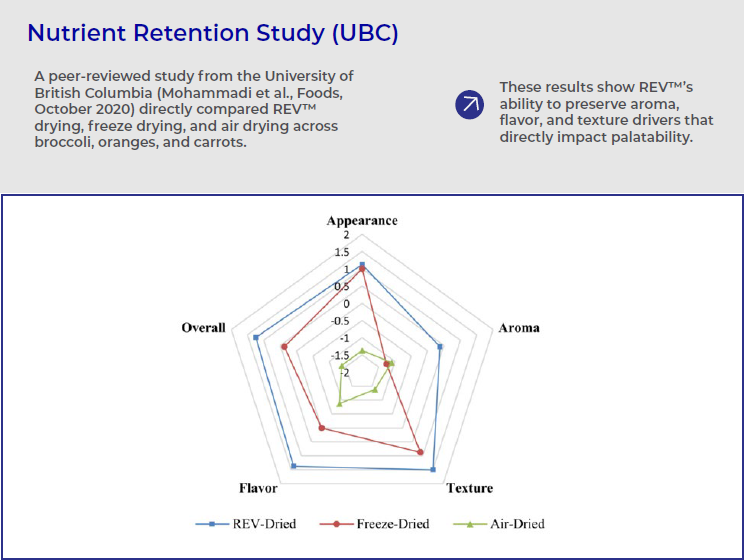
Vacuum microwave drying can create different textures depending on the product structure and drying profile. Rapid internal vapor generation may create pores or expansion, which can support crisp, light, or porous products.
The final texture is influenced by:
- Initial moisture.
- Product thickness.
- Microwave power density.
- Pressure.
- Drying time.
- Solids composition.
- Pretreatment.
- Final water activity.
For example, a manufacturer developing a crunchy fruit snack may want a different structure from a company making a chewy protein piece or a soluble dairy powder. The process must be designed around the intended bite or reconstitution behavior.
How does vacuum microwave drying compare with commercial freeze drying?
Vacuum microwave drying and commercial freeze drying use different mechanisms. Freeze drying freezes water and removes it through sublimation. Vacuum microwave drying removes water through evaporation under reduced pressure while microwave energy accelerates internal heating.
Commercial freeze drying can deliver strong structure retention for some products, but it may involve long cycles and high energy requirements. Vacuum microwave drying can provide shorter cycles and a different balance of throughput, quality, and operating cost.
The right drying method depends on the product. A drying method comparison should assess:
| Evaluation area | Questions to ask |
|---|---|
| Product quality | Does the method preserve the required color, flavor, and structure? |
| Nutrient preservation | Which nutrients or bioactives need protection? |
| Moisture control | Can the process reach a consistent endpoint? |
| Throughput | Can it meet expected production volumes? |
| Energy use | What is the energy cost per kilogram? |
| Scale | Can the process move from pilot to commercial production? |
| Packaging | Will the dried product remain stable after packaging? |
This comparison is more useful than assuming one method is best for every food.
What is process control in vacuum microwave dehydration?
Process control in vacuum microwave dehydration means managing the variables that determine how energy and moisture move through the product. It includes controlling pressure, microwave power, loading, geometry, time, temperature, moisture, water activity, and packaging.
A process-control framework can be summarized as follows.
| Process variable | What it influences |
|---|---|
| Vacuum pressure | Boiling point and evaporation conditions |
| Microwave power density | Heating rate and drying speed |
| Product thickness | Moisture path and uniformity |
| Loading pattern | Energy distribution and batch consistency |
| Drying time | Final moisture and texture |
| Product temperature | Nutrient, color, and flavor protection |
| Final water activity | Shelf stability and microbial control |
| Packaging | Moisture regain and oxidation protection |
The purpose is to build a repeatable relationship between these variables and the final product.
How does packaging fit into quality preservation?
Packaging protects the dried product from moisture regain, oxygen, light, and physical damage. Even a well-controlled drying process can lose its benefit if the package allows humidity to enter or oxygen to accelerate quality changes.
Packaging development should consider:
- Moisture vapor transmission.
- Oxygen transmission.
- Seal integrity.
- Headspace conditions.
- Distribution humidity.
- Temperature changes.
- Opening and resealing behavior.
This is particularly important for crisp snacks, powders, and porous products. Their structure can absorb moisture quickly if the package is not matched to the product’s sensitivity.
How should manufacturers develop a repeatable process?
Manufacturers should develop a repeatable process by linking each operating setting to measurable product outcomes. The first step is to define the product requirements clearly.
These may include:
- Target texture.
- Target color.
- Final moisture range.
- Water activity range.
- Nutrient or bioactive retention.
- Rehydration or dissolution performance.
- Shelf life.
- Production throughput.
The team can then test process conditions systematically rather than changing multiple variables without tracking the result.
A robust development program should include repeated runs, not a single successful batch. It should also evaluate product variability, since ingredients can change by season, source, size, maturity, and composition.
What does EnWave’s REV™ technology control?
EnWave describes REV™ as combining vacuum and microwave energy to create a rapid, gentle drying process. By controlling pressure and microwave power density, the system can influence product temperature and final moisture.
That makes REV™ relevant for manufacturers focused on moisture control in food processing. The technology can be evaluated for products such as fruits, vegetables, dairy, meats, snacks, ingredients, and other food formats.
The final result still depends on the product and the process. EnWave’s role is to support product trials, process development, equipment selection, and scale-up so the manufacturer can identify the conditions that meet its quality and commercial requirements.
How should teams validate quality at scale?
Teams should validate quality at scale by testing the same process under representative production conditions. This includes commercial loading patterns, realistic batch sizes, packaging, and storage.
Validation should compare:
- Pilot and commercial product quality.
- Moisture uniformity.
- Water activity.
- Texture distribution.
- Nutrient or bioactive retention.
- Color and flavor.
- Yield and production time.
- Shelf life after packaging.
Scale-up can change the energy distribution, vapor path, loading density, and cycle behavior. That is why commercial-scale drying evaluation is an important step before finalizing a production process.
What should manufacturers ask a drying technology supplier?
Manufacturers should ask suppliers for clear information about the process, expected outcomes, and support available during development. Useful questions include:
- Which product types has the system processed?
- What operating variables can be controlled?
- How is microwave power distributed?
- How is final moisture measured?
- What pilot equipment is available?
- Can the system support batch and continuous production?
- What quality data is available for similar products?
- How are operators trained?
- What support is available during scale-up?
- How are service, maintenance, and spare parts managed?
These questions help teams evaluate food processing technology on practical criteria rather than relying on broad claims.
Conclusion
Vacuum microwave dehydration works by controlling pressure and microwave energy to remove moisture rapidly under reduced-temperature conditions. However, quality does not come from speed alone. It comes from managing pressure, power density, product geometry, loading, time, temperature, final moisture, water activity, and packaging as a connected process.
For manufacturers, the goal is to create a repeatable process that reaches the required endpoint while preserving the intended color, flavor, structure, nutrients, and shelf life. REV™ is relevant because it gives food processing teams a platform for controlling key drying parameters and developing scalable products.
The practical rule is simple. Do not choose a drying process only because it is fast. Choose the process that delivers the quality you need, at the scale your business requires, with control you can repeat.
FAQ
What is vacuum microwave dehydration?
Vacuum microwave dehydration combines reduced pressure with microwave energy to remove moisture rapidly while controlling product temperature and final moisture.
Why is vacuum used in microwave drying?
Vacuum lowers the boiling point of water, allowing moisture to evaporate at lower product temperatures and supporting low temperature dehydration.
Is higher microwave power always better?
No. Higher power may increase drying speed but can also create uneven heating or damage texture and quality. The goal is to use a controlled power density that reaches the target endpoint without over-processing the product.
What affects moisture control in food processing?
Pressure, microwave power, product thickness, loading pattern, drying time, temperature, final water activity, and packaging all affect moisture control.
How does vacuum microwave drying support nutrient preservation?
It can reduce heat exposure through lower-pressure evaporation and shorter drying cycles. Nutrient retention must still be validated for the specific product and process.
How does vacuum microwave drying compare with commercial freeze drying?
Vacuum microwave drying can offer shorter cycles and a different balance of throughput, quality, and energy use. Commercial freeze drying may remain suitable for products requiring specific structural or rehydration characteristics.
What is the difference between moisture content and water activity?
Moisture content measures the amount of water in a product. Water activity measures how available that water is for microbial growth and chemical reactions. Both may be needed for shelf-life and quality evaluation.
Can REV™ process different food products?
REV™ can be evaluated for a range of food products, including fruits, vegetables, dairy, meats, snacks, and ingredients. The correct process parameters depend on the product and desired outcome.
How should a company validate a vacuum microwave drying process?
A company should validate repeated runs using representative product geometry, loading, processing conditions, packaging, and storage. Testing should include moisture uniformity, water activity, texture, color, flavor, nutrient retention, yield, and shelf life.
Further reading
EnWave precise moisture control in industrial drying
EnWave REV™ technology overview
EnWave how does REV™ technology work
EnWave is dehydrated food still nutritious
Advances in Vacuum Microwave Drying for Berries
Effect of microwave power on drying kinetics and water activity
Influence of microwave power and foam thickness on drying
Evaluation of dried carrot properties after microwave-vacuum and freeze drying