

Freeze Drying Alternatives for Food Startups in 2026

Food startups do not need to default to commercial freeze drying equipment when speed, scalability, and market timing matter. The best path is often a decision between buying, toll manufacturing, or licensing a drying platform that gets the product to market sooner. REV™ vacuum microwave drying is a strong alternative because it supports faster drying, better quality retention, and a clearer route from pilot to production.

Why are food startups rethinking freeze drying in 2026?
Food startups are rethinking freeze drying because the equipment can be expensive, slow, and hard to scale early on. Commercial freeze drying equipment can preserve quality well, but long batch cycles and high capital needs often create delays that startups cannot afford. In 2026, many founders want a faster path to launch and a more flexible food processing strategy.
That is why food dehydration machinery is being judged on more than output. Startups are asking whether the system can help with product development, cost control, and speed to shelf. For many teams, the question is no longer whether freeze drying works. It is whether it is the best commercial food preservation choice for their stage of growth.
What should a startup compare before buying equipment?
A startup should compare equipment on the business outcome, not just the technical spec sheet. Commercial food preservation decisions affect capital, staffing, shelf life, and launch timing. That means the best option is usually the one that aligns with the product and the go to market plan.
A practical comparison should include:
- Upfront capital cost.
- Cycle time and throughput.
- Product quality after drying.
- Floor space requirements.
- Energy use.
- Scale-up potential.
- Whether the process fits the target texture and shelf life.
If the equipment solves one problem but creates three new ones, it is probably not the right startup food processing equipment.
When does commercial freeze drying make sense?
Commercial freeze drying makes sense when the brand needs premium preservation and the economics can support it. It is often used for products where structure, rehydration, or a premium visual profile matter most. Some startups can make that work, especially if the product is already priced as a premium item.
But freeze drying technology is not always the fastest route to market. Many startups need a simpler way to validate the product, secure early sales, and avoid overinvesting before demand is proven. In those cases, other drying technology options can be a better fit.
What are the main freeze drying alternatives for food startups?
The main freeze drying alternatives are REV™ vacuum microwave drying, toll manufacturing, and licensing. Each path supports a different stage of startup growth, and the right choice depends on capital, speed, and product type.
1. Buy commercial freeze drying equipment
This is the most direct ownership path, but it also carries the most risk and the highest capital burden. It works best for startups with strong funding, clear demand, and a product that truly needs freeze drying.
2. Use REV™ drying equipment
This is often a better fit for startups that need faster drying, better quality retention, and a more scalable path. EnWave says REV uses vacuum and microwave energy to create a rapid, gentle drying process with precise moisture control.
3. Toll manufacture
This lets the startup launch without buying equipment right away. It can be a strong bridge between product development and full production.
4. License the technology
Licensing can create a longer-term scale strategy. It is useful when the brand wants to own the product story while partnering on manufacturing capability.
These are not just equipment choices. They are business model choices.
Why is REV™ a strong option for startup food processing equipment?
REV™ is a strong option because it gives startups a way to dry products quickly without waiting days for a batch to finish. EnWave describes REV as a patented vacuum microwave drying process that dehydrates food more efficiently while maintaining quality. That matters when a startup needs to test, refine, and launch without a long delay.
The practical benefits are easy to understand.
- Faster cycles.
- Lower temperature processing.
- Better retention of colour, flavour, and nutrients.
- Smaller footprint than many other methods.
- Flexibility for batch or continuous operation.
For a startup, that can be the difference between an idea and a commercial product.
How does REV™ compare with freeze drying on speed?
REV™ is much faster than freeze drying for many products. EnWave’s comparison materials show REV can dry products in about 30 to 90 minutes, while freeze drying can take 20 to 72 hours. That time gap is especially important for startups that need rapid iteration.
Speed matters because food innovation rarely succeeds on the first try. Founders need to make changes, run new batches, and react to customer feedback. A faster process shortens each of those loops and helps reduce the cost of product development.
How does REV™ compare on product quality?
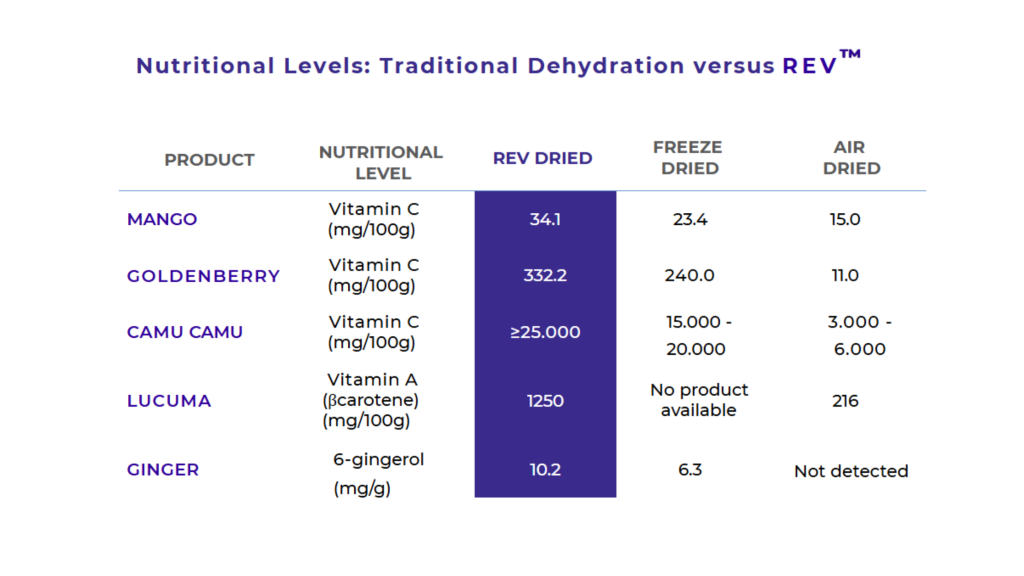
REV™ is designed to preserve quality while drying faster. EnWave says the process helps keep natural colour, flavour, and nutrients because drying happens under vacuum and at lower temperatures. That makes it appealing for fruit, vegetables, dairy, snacks, and other sensitive products.
The process is also useful because it can create different textures. In EnWave’s materials, REV can support outcomes that range from chewy to crunchy depending on the product. That gives startups more room to build a differentiated food innovation story.
What should startups do if they are not ready to buy equipment?
Startups that are not ready to buy equipment should consider toll manufacturing or licensing first. This can reduce risk and help the brand learn what the market actually wants before investing in full ownership. It also keeps the startup focused on customer demand rather than machinery.
A simple decision path looks like this.
- Validate the product concept.
- Test market reaction in a toll manufacturing setup.
- Confirm shelf life and repeatability.
- Decide whether ownership, licensing, or partnership makes the most sense.
- Scale only after the product has proven demand.
This approach is often safer than buying commercial freeze drying equipment too early.
How do toll manufacturing and licensing help market entry?
Toll manufacturing helps because it gives the startup access to production without a large equipment purchase. That can shorten the path from prototype to retail and reduce the need for immediate capital. Licensing can go a step further by giving the startup a structured way to grow with the technology provider.
These paths are especially useful when speed matters. Many founders want to launch, learn, and adapt before they commit to a permanent facility. That is why toll manufacturing and licensing are becoming important tools in startup food processing equipment strategy.
What types of products fit REV™ well?
REV™ fits products that need good shelf life, strong sensory quality, and a premium or differentiated texture. That includes fruit snacks, vegetable snacks, cheese snacks, ingredients, and other shelf stable foods. It also fits products that need to keep a natural look and feel after drying.
The Solve Foods case study is a good example. The company used REV™ to create a light, crunchy fruit snack that preserved the real identity of the fruit while feeling new to consumers. That is a useful model for startups that want food innovation without giving up practicality.
How should founders choose between buying and partnering?
Founders should choose based on stage, funding, and risk tolerance. If the startup has capital, a clear market, and a product that truly requires freeze drying, buying may make sense. If the company needs to move quickly or wants to reduce risk, partnering may be smarter.
A quick rule helps.
- Buy when the market is proven and volume is expected.
- Partner when the product still needs validation.
- License when the technology is central to the business.
- Toll manufacture when speed to market matters most.
That framework can keep a founder from making an expensive decision too early.
What should food startups ask before choosing freeze drying technology?
Food startups should ask a few practical questions before choosing a drying path.
- How fast do we need to launch.
- What texture and appearance does the product need.
- Can we support the capital cost.
- Do we need continuous processing later.
- Is this a premium preservation problem or a scale problem.
Those questions often reveal whether commercial freeze drying equipment is truly necessary or whether REV™ or a partnership model makes more sense.
Conclusion
For food startups in 2026, commercial freeze drying equipment is only one option, not the default answer. Many teams will move faster and smarter by comparing freeze drying with REV™ drying, toll manufacturing, and licensing paths that support earlier market entry. The right choice depends on whether the startup needs the highest preservation level, the fastest route to shelf, or the most scalable business model.
REV™ stands out because it combines speed, quality retention, and flexibility in a way that fits startup food innovation. For founders weighing food dehydration machinery, the best question is not “Which dryer is best?” It is “Which path gets the product to market with the least friction and the most room to grow?”
FAQ
Is commercial freeze drying equipment worth it for startups?
It can be, but only when the product, price point, and growth plan justify the cost and cycle time.
What is the main advantage of REV™ over freeze drying?
The main advantage is speed with quality retention. REV can dry many products far faster than freeze drying while keeping strong sensory results.
Should a startup buy equipment or use toll manufacturing first?
Many startups should use toll manufacturing first because it lowers risk and speeds up launch.
Is REV™ good for product development?
Yes. REV is useful for product development because it supports rapid iteration, quality retention, and scalable production planning.
What is the best freeze drying alternative for food startups?
There is no single best answer, but REV™ is one of the strongest alternatives when speed, scalability, and product quality all matter.
Can licensing help with startup food processing equipment?
Yes. Licensing can help startups access technology and scale without shouldering the full burden of ownership too early.
Further reading
EnWave How does Freeze Drying compare to Vacuum Microwave Drying
https://www.enwave.net/fr/how-does-freeze-drying-compare-to-vacuum-microwave-drying
EnWave Why freeze drying can’t do continuous processing
EnWave Vacuum Microwave Dehydration Vs Freeze Drying
ScienceDirect Microwave Drying
https://www.sciencedirect.com/topics/agricultural-and-biological-sciences/microwave-drying
Food Machinery Int Microwave dehydrator overview
https://www.foodmachineryint.com/everything-you-need-to-know-about-microwave-dehydrator-in-2024