

The Complete Guide to Food Drying Scale-Up in 2026
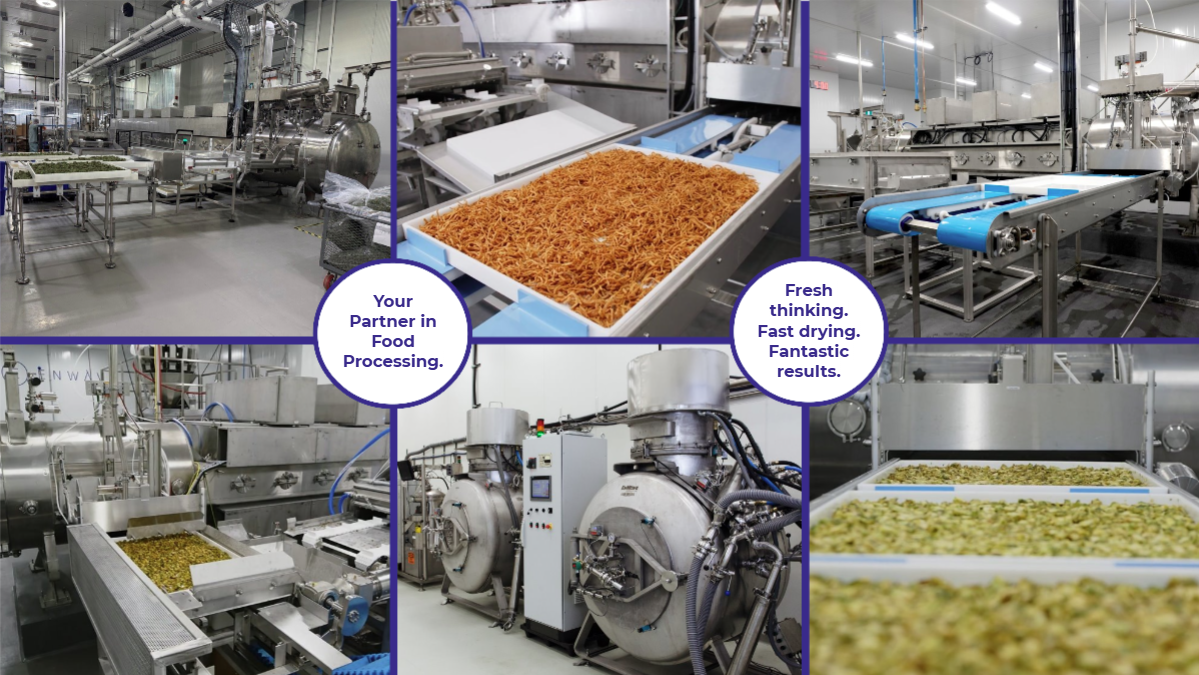
Scaling a food drying operation from pilot batches to full commercial production is one of the most complex decisions your R&D and manufacturing teams will face. The drying method you select affects nutrient retention, texture consistency, throughput capacity, energy consumption, and your overall cost per kilogram. A wrong choice at this stage can delay commercialization by months and lock your facility into equipment that limits future product innovation.
This guide walks through every factor that determines whether a commercial food drying technology will perform at production scale: from the core science behind industrial drying to the specific criteria that separate scalable systems from those that stall at pilot. You will also find a comparison of major drying methods, a step-by-step scale-up framework, and answers to the most common questions food processors ask during technology selection.
Key Takeaways
- Your drying technology choice directly determines nutrient retention, texture quality, and production throughput at commercial scale.
- Cycle time, energy use, and moisture control precision are the three most critical metrics for comparing industrial drying systems.
- Pilot validation with your actual product formulations is non-negotiable before committing capital to a full-scale installation.
- EnWave Corporation’s REV™ vacuum microwave dehydration offers cycle times measured in minutes, not days, with precise moisture targeting.
- Toll drying and machine rental models reduce financial risk during the transition from R&D to commercial volumes.
What Is Commercial Food Drying and Why Does Scale-Up Matter?
Commercial food drying removes moisture from raw or semi-processed ingredients to extend shelf life, reduce weight for shipping, and create stable formats for retail or food service distribution. At small volumes, many drying approaches work adequately. The challenge appears when you need to maintain identical quality metrics across thousands of kilograms per day.
Scale-up matters because drying behavior changes with batch size. Heat distribution, airflow patterns, and moisture migration all shift when you move from a 10-kilogram test batch to a 500-kilogram production run. A method that produces uniform results at bench scale can generate inconsistent moisture levels and variable textures at industrial volumes.
For product development leaders, this means the drying system that performed well in your lab may not deliver the same nutrient retention or sensory profile once you scale. Evaluating technology at production-relevant volumes, early in the development process, saves time and prevents costly reformulation.
How Industrial Drying Methods Differ in Performance
Each industrial drying method operates on a distinct physical principle, and those principles dictate its strengths, limitations, and scalability profile. Understanding these differences is the foundation for making a sound technology decision.
Convective Heat Drying
Convective systems push heated air across product surfaces to evaporate moisture. They are common in vegetable and herb processing because the equipment is relatively simple and the capital cost is low. Cycle times range from 6 to 48 hours depending on the product, and temperatures typically run between 50°C and 80°C.
The trade-off is quality. Extended exposure to heat and oxygen accelerates nutrient degradation, causes color changes, and can produce case-hardened surfaces where the exterior dries faster than the interior. Scaling convective dryers also requires significant floor space and careful airflow engineering to maintain uniformity across large batch volumes.
Drum Drying
Drum dryers apply a thin film of liquid or puréed product to a heated rotating drum. The film dries in seconds and is scraped off as flakes or powder. This method works well for starchy products like potato flakes and certain fruit purées. Because the product contacts a hot metal surface directly, heat-sensitive vitamins and bioactive compounds can degrade quickly. Drum drying is best suited for products where the final format is a powder and nutrient sensitivity is not the primary concern.
Spray Drying
Spray drying atomizes a liquid feed into fine droplets inside a chamber filled with hot air (inlet temperatures between 150°C and 225°C). Moisture evaporates almost instantly, and the resulting powder collects at the base. This method is the standard for milk powder, instant coffee, and encapsulated flavors.
Spray drying is fast and operates at high throughput, but it requires a liquid feedstock. Whole fruits, vegetables, proteins, and intact food pieces cannot be spray dried. The high inlet temperatures also risk denaturing heat-sensitive compounds, although the brief exposure time helps limit damage.
Vacuum Microwave Dehydration (REV™ Technology)
Vacuum microwave dehydration combines volumetric microwave energy with reduced atmospheric pressure. EnWave Corporation developed and patented this approach as REV™ (Radiant Energy Vacuum™) technology. Microwave energy heats the product from the inside out, and the vacuum environment lowers the boiling point of water so moisture evaporates at lower temperatures.
This combination produces cycle times of 30 to 90 minutes for most products, compared with hours or days for other methods. Because the process operates at low temperatures under vacuum, EnWave’s REV™ technology preserves natural colors, flavors, aromas, and nutrients at rates that match or exceed those of conventional vacuum processes. Precise moisture control (targeting anywhere from 1% to 40% residual moisture) lets you dial in textures from crunchy to intermediate with batch-to-batch consistency.
What Metrics Should You Evaluate When Comparing Drying Technologies?
Selecting a drying system for scale-up is a multi-variable decision. Focusing on a single metric, like cost per unit, without accounting for nutrient retention or cycle time can lead to equipment choices that limit your product portfolio. Here are the metrics that matter most.
Cycle Time and Throughput
Cycle time measures how long a single batch takes from wet input to finished dry product. Shorter cycle times mean higher throughput per machine, fewer machines needed, and faster product development iteration. For R&D teams running prototype trials, a system that completes a batch in under two hours allows multiple formulation tests per day instead of one test per week. For a deeper comparison, EnWave has published a guide on food drying tech selection for product innovation.
Nutrient Retention and Bioactive Preservation
Nutrient retention measures how much of the original vitamin, mineral, and antioxidant content survives the drying process. This metric is especially critical for functional foods, clean-label snacks, and nutraceutical ingredients where nutritional claims drive consumer purchase decisions. Methods that use lower temperatures and shorter exposure times generally deliver higher retention rates.
Texture Control and Consistency
Texture is both a quality metric and a consumer expectation. Your drying method must produce a consistent texture profile across every batch. Systems with precise moisture control allow you to target specific textures (crunchy, crispy, or intermediate) and reproduce them reliably. Inconsistent texture leads to product rejections, rework, and wasted raw material.
Energy Consumption Per Kilogram
Energy cost is a significant component of your per-unit production cost. Some drying methods consume substantially more energy per kilogram of water removed. EnWave Corporation’s REV™ systems use approximately one-third the energy of comparable vacuum-based processes, which directly reduces your operating expense at commercial volumes.
Floor Space and Facility Requirements
The physical footprint of your drying equipment affects your facility layout, expansion options, and capital planning. Systems that deliver high throughput in a compact footprint give you more flexibility. EnWave’s commercial-scale REV™ machines (60kW to 120kW) fit in a space of approximately 50 by 11 feet and remove 40 to 83 kilograms of water per hour, depending on configuration.
Step-by-Step Framework for Scaling Food Drying Production
Moving from lab-scale drying to commercial production requires a structured process. Skipping steps or compressing timelines leads to quality problems, equipment mismatches, and delayed market entry. Follow this framework to reduce risk at each stage.
Step 1: Define Your Product and Quality Specifications
Start by documenting your target moisture content, texture profile, nutrient retention thresholds, and shelf life requirements. These specifications become your acceptance criteria throughout the scale-up process. If your product requires a specific vitamin retention level for a label claim, that number must be validated at every production volume.
Step 2: Run Feasibility Trials at Pilot Scale
Before committing to a drying technology, run your actual product through the system at pilot scale. EnWave Corporation offers product development packages at its Canadian pilot plant facility, where your formulations are tested on 10kW REV™ machines with customizable drying parameters. These trials generate the processing data (cycle time, moisture curve, retention metrics) you need for an informed technology decision.
Step 3: Optimize Processing Parameters
Use pilot trial data to optimize your drying recipe: microwave power density, vacuum pressure, rotation speed (for tumble drying), or tray loading density (for tray-based systems). Small adjustments at this stage can significantly improve throughput, reduce energy use, and fine-tune texture. Document every parameter change and its effect on your quality specifications.
Step 4: Validate at Pre-Commercial Volume
Run production-representative batches to confirm that your optimized parameters hold at larger volumes. This step is where many drying technologies reveal inconsistencies. Heat distribution that was uniform in a 10-kilogram batch may become uneven at 200 kilograms. Validate moisture uniformity, texture, and nutrient retention across multiple consecutive runs.
Step 5: Select Your Commercial Model
Based on your validated data, choose the equipment configuration and business model that fits your operation. EnWave Corporation offers multiple pathways: machine purchase and licensing for full in-house control, toll drying through REVworx for outsourced production, or machine rental for flexible capacity during ramp-up.
Step 6: Install, Commission, and Scale
After equipment arrives, commission the system with your validated processing parameters. Run qualification batches to confirm performance matches your pilot and pre-commercial results. EnWave’s partner support includes installation, operator training, and 24/7 remote troubleshooting to reduce commissioning timelines and production downtime.
How REV™ Technology Addresses Common Scale-Up Bottlenecks
Product development pipelines stall when the drying step becomes the rate-limiting factor. Long cycle times delay prototype iterations, inconsistent moisture control forces rework, and energy-intensive processes erode margins as volumes increase. REV™ technology from EnWave Corporation addresses each of these constraints directly.
Faster Iteration for R&D Teams
With cycle times of 30 to 90 minutes, your R&D team can run multiple drying trials per day rather than waiting 24 to 48 hours for a single batch. This acceleration compresses your product development timeline and helps you bring innovations to market ahead of competitors who are constrained by slower drying methods.
Consistent Batch-to-Batch Quality
REV™ dries products volumetrically, meaning microwave energy penetrates the material uniformly rather than relying on surface heat transfer. Combined with closed-loop vacuum pressure control, this produces consistent moisture levels across every batch. You reduce rejections, minimize waste, and maintain the quality standards your customers expect.
Scalable Equipment From Pilot to Full Production
EnWave’s machine range scales from the 10kW pilot unit (9 kg water removal per hour) to the REV100 and REV120 kW commercial systems (80 to 83 kg water removal per hour). Because the core drying mechanism stays the same across all machine sizes, processing parameters validated at pilot scale transfer directly to production scaling with minimal re-optimization.
What Role Does Nutrient Retention Play in Drying Technology Selection?
For food processors focused on functional nutrition, clean-label positioning, or premium ingredient supply, nutrient retention is not optional. It is a core product specification that determines label claims, consumer value perception, and regulatory compliance.
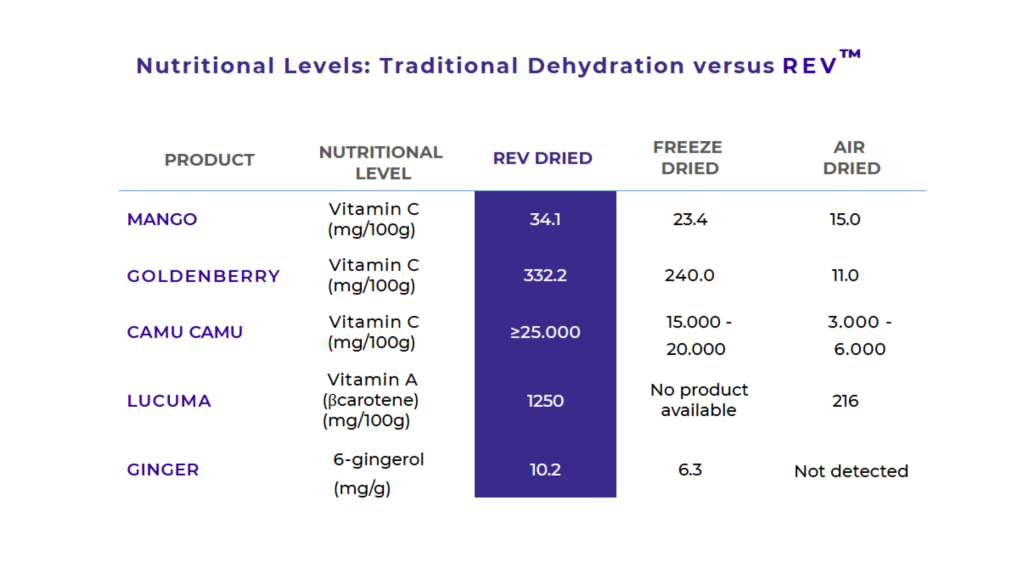
Drying methods that apply high heat over extended periods degrade heat-sensitive vitamins (particularly vitamin C and B-complex vitamins), antioxidants, and bioactive compounds. According to research from Virginia Tech’s Cooperative Extension (2025), dehydrated foods can lose a significant portion of their vitamin content depending on temperature and duration of the drying process.
EnWave Corporation’s REV™ process operates at lower effective temperatures and completes drying in a fraction of the time, which limits thermal exposure and preserves a higher percentage of the original nutrient profile. For applications where retention of ascorbic acid, antioxidant activity, or protein integrity matters, this performance difference translates directly into stronger label claims and higher-value finished products.
How to Evaluate Drying Technology for Texture Quality at Scale
Texture is one of the first attributes consumers notice, and it is one of the hardest to maintain as production volume increases. Batch variability in moisture content creates texture inconsistencies that lead to product rejections, rework costs, and compromised brand reputation.
When evaluating a drying system for texture quality, focus on three factors: moisture control precision, the uniformity of energy distribution across the product bed, and the system’s ability to target a specific residual moisture percentage. EnWave’s REV™ technology targets moisture levels anywhere from 1% to 40%, giving you the control to produce crunchy snack chips, intermediate-texture bites, or powder formats from the same platform.
Volumetric heating (where energy is absorbed throughout the product rather than just at the surface) eliminates the uneven drying patterns that cause case hardening or moisture pockets in the center of thicker product pieces. This is especially important for food innovation projects where you need to deliver a novel texture that differentiates your product on shelf.
Energy Efficiency and Sustainability in Commercial Drying
Energy consumption is a growing factor in drying technology decisions. Rising utility costs, corporate sustainability commitments, and consumer demand for lower-carbon products all push food processors toward more efficient drying systems.
Vacuum microwave systems like REV™ use approximately one-third the energy per kilogram of water removed compared with equivalent vacuum-based processes. The lower energy requirement comes from the efficiency of volumetric microwave heating: energy transfers directly to water molecules inside the product, rather than heating the surrounding air or chamber walls first.
EnWave’s closed-loop drying process also produces zero hazardous emissions, zero chemical byproducts, and minimal waste heat. For manufacturers pursuing sustainability certifications or carbon footprint reduction targets, these operational characteristics matter during equipment evaluation. Lighter dried products also reduce transportation costs and associated emissions, extending the sustainability benefit beyond the drying step itself.
Regulatory Compliance and Food Safety in Scaled Drying Operations
Scaling your drying operation introduces new regulatory requirements. Production facilities must meet HACCP (Hazard Analysis Critical Control Points) protocols, and many retail and food service buyers require BRC (Brand Reputation Compliance) or equivalent third-party certification.
Your drying equipment should support compliance by design. Closed systems that minimize product exposure to ambient air reduce contamination risk. Precise temperature and moisture monitoring creates the documentation trail auditors require.
For operations processing organic, kosher, or allergen-controlled products, verify that your drying partner or equipment supplier can accommodate the segregation, cleaning, and documentation standards those programs demand.
How to Reduce Financial Risk During Drying Scale-Up
Capital equipment purchases represent one of the largest financial commitments in a food processing scale-up. The wrong choice ties up capital in equipment that may not match your product portfolio or market demand.
Three strategies reduce financial risk during drying scale-up:
Rent before you buy. Machine rental lets you operate the equipment in your own facility to confirm it meets your throughput, quality, and integration requirements. EnWave offers 10kW pilot machines on flexible rental terms for this purpose.
License the technology. Technology licensing gives you access to REV™ drying without developing the process engineering from scratch. EnWave’s technology evaluation and license option pathway includes access to processing protocols, parameter libraries, and ongoing technical support.
What Applications Are Driving Food Drying Scale-Up in 2026?
Several product categories are generating significant scale-up activity in the food drying sector. Understanding where the demand is growing helps you position your own product development efforts.
Clean-Label Snacks and Fruit Chips
Consumer demand for snacks made with recognizable ingredients and no added oils or flavor coatings continues to grow. Dried fruit chips, vegetable crisps, and cheese snacks require a drying method that delivers a satisfying crunch without deep frying. REV™ technology produces oil-free, clean-label snacks with vibrant color and retained flavor in cycle times under two hours.
Premium Pet Treats
Pet owners increasingly prioritize functional nutrition and natural ingredients. Dried protein treats (chicken, beef, organ meats) that retain natural flavor and high palatability scores command premium pricing. EnWave’s REV™ process has been shown to deliver 97% to 100% acceptability rates in palatability studies conducted at USDA-registered facilities.
Functional Ingredients and Nutraceuticals
The functional food market depends on ingredients that retain their bioactive properties through processing. Dried fruit powders, herbal extracts, and probiotic carriers all require gentle drying to preserve potency.
Upcycled Food Products
Processing surplus or cosmetically imperfect produce into premium dried powders and ingredients reduces food waste while creating new revenue streams. Fast, scalable drying makes upcycling economically viable. A seasonal harvest surplus that would otherwise go to waste can be converted into shelf-stable powder formats in hours rather than days.
Choosing the Right Drying Technology for Your Scale-Up
The right drying technology for your scale-up depends on your product requirements, production volume targets, capital budget, and time-to-market goals. No single method is optimal for every application, but the decision framework is consistent.
Prioritize cycle time if speed to market and R&D iteration velocity are your primary constraints. Prioritize nutrient retention if your product competes on nutritional claims or functional benefits. Prioritize energy efficiency if your margins are tight and your volumes are high. In most scale-up scenarios, you will need a technology that performs well across all three dimensions simultaneously.
EnWave Corporation’s REV™ vacuum microwave dehydration delivers across these dimensions: 30 to 90 minute cycle times, high nutrient retention rates, and approximately one-third the energy use of comparable vacuum processes, all from equipment that scales from a 10kW pilot unit to 120kW commercial systems. Book a discovery call with EnWave’s team to discuss your specific product, volume requirements, and the most efficient path from R&D to commercial production.
FAQs
What is the fastest commercial food drying method available?
Vacuum microwave dehydration is among the fastest commercial drying methods. EnWave Corporation’s REV™ technology completes most food drying cycles in 30 to 90 minutes.
This is significantly faster than convective or vacuum-based alternatives, which can take 6 to 48 hours depending on the product and batch size.
How does drying method affect nutrient retention in food?
Drying method directly affects nutrient retention through two variables: temperature and exposure time. Higher temperatures and longer cycle times degrade heat-sensitive vitamins and antioxidants.
Methods that operate at lower temperatures for shorter durations, like vacuum microwave dehydration, preserve a higher percentage of the original nutrient profile.
What should you look for when choosing a drying system for scale-up?
Focus on cycle time, nutrient retention, texture consistency, energy consumption, and the ability to validate performance at pilot scale before committing capital.
Flexible business models (contract manufacturing, rental, licensing) reduce financial risk during the transition from R&D to commercial production.
What types of food products benefit most from vacuum microwave drying?
Products where nutrient retention, texture quality, and speed to market matter most benefit from vacuum microwave drying. This includes clean-label snacks, fruit and vegetable chips, premium pet treats, and functional ingredients.
EnWave Corporation’s REV™ platform handles fruits, vegetables, dairy, proteins, herbs, and encapsulated ingredients.
How does EnWave Corporation’s REV™ technology preserve texture during drying?
REV™ uses volumetric microwave energy to heat products uniformly from the inside out, combined with vacuum pressure control. This eliminates uneven surface drying and case hardening.
You can target specific moisture levels (1% to 40%) to produce crunchy, crispy, or intermediate textures with batch-to-batch consistency.
How does energy efficiency differ across industrial drying methods?
Energy efficiency varies significantly. Convective dryers lose heat to the surrounding air, while vacuum microwave systems transfer energy directly to water molecules in the product.
EnWave Corporation’s REV™ systems use approximately one-third the energy of equivalent vacuum-based drying methods, reducing operating costs at commercial volumes.
How long does it take to scale from pilot trials to commercial food drying?
Timeline varies by product complexity and regulatory requirements, but a typical path from pilot trials to initial commercial production takes 3 to 12 months.
Starting with toll drying can shorten this timeline significantly, since you bypass equipment procurement and facility build-out.
Further reading
EnWave Popular food drying processes explained
EnWave How modern dehydration brings the farm to your table year round
EnWave The REV technology from EnWave
https://www.anugafoodtec.com/magazine/revolutionizing-food-dehydration.php
ScienceDirect Microwave Drying
https://www.sciencedirect.com/topics/agricultural-and-biological-sciences/microwave-drying
Comparison of drying methods for agricultural products
https://ijsra.net/sites/default/files/IJSRA-2024-0222.pdf
New efficient drying methods

