

How Do You Dry Food Without Losing Nutrients?
Drying food without losing nutrients is not about finding a process that preserves everything. No commercial food dehydration method retains every vitamin, pigment, aroma compound, enzyme, and bioactive equally.
The practical goal is to minimize avoidable losses while reaching a safe, stable, and commercially useful endpoint. That requires balancing product temperature, drying time, oxygen exposure, moisture removal, texture, and throughput.
To dry food while retaining as much nutritional and sensory value as practical, follow four rules:
- Control temperature. Avoid unnecessary heat exposure and damaging temperature peaks.
- Reduce drying time. A low temperature is not automatically gentle if the product remains exposed for many hours.
- Limit oxygen exposure. Oxygen can accelerate losses of vitamin C, carotenoids, polyphenols, natural pigments, and volatile compounds.
- Reach the correct moisture and water-activity endpoint. Under-drying can compromise stability, while over-drying extends processing and may expose the product to more heat than necessary.
The best operating window varies by food, ingredient, geometry, pretreatment, and target quality. Research shows that temperature, oxygen, moisture, enzymes, light, and processing duration can affect different bioactive compounds in different ways. Vitamin C is particularly sensitive, while minerals, fiber, proteins, carotenoids, polyphenols, and volatile compounds each respond differently to processing conditions and the surrounding food matrix.
Vacuum microwave dehydration can bring all four rules into one controllable food dehydration technology. By combining reduced pressure with energy absorbed within the product, it can support lower-temperature evaporation, faster moisture removal, limited oxygen exposure, and a defined final endpoint. Outcomes remain product- and protocol-specific, so validation is essential.
Why does food lose nutrients during drying?
Food can lose nutrients during drying because heat, oxygen, enzymes, moisture, and time create conditions for chemical and physical change.
Vitamin C can undergo oxidation and hydrolysis and is often used as an indicator of processing severity because it is water-soluble and sensitive to heat and oxygen. Carotenoids may be affected by oxidation, isomerization, and enzymes such as lipoxygenase. Polyphenols and flavonoids can oxidize or transform, while aroma compounds may evaporate because many are volatile and have relatively low boiling points.
This does not mean that the lowest possible temperature will always produce the best result. Drying at a very low temperature may extend the process, increasing cumulative exposure to oxygen and active enzymes. Conversely, excessive temperature can accelerate thermal degradation or volatilization. Nutrient-preserving food drying therefore depends on the combined time-temperature history, not temperature alone.
The raw material matters too. Cultivar, maturity, slice thickness, surface area, formulation, pH, fat and sugar content, and pretreatment can all change the way heat and moisture move through a product. This is why a protocol developed for carrots should not automatically be applied to herbs, dairy ingredients, fruit pieces, proteins, or botanical extracts.
What process variables affect nutrient retention?
| Process variable | Primary quality outcome | Practical R&D consideration |
|---|---|---|
| Product temperature | Vitamin stability, pigment retention, protein functionality, browning, aroma | Monitor the product rather than relying only on chamber or air temperature. Control temperature peaks as moisture falls. |
| Drying time | Cumulative thermal and oxidative exposure | Compare total exposure time, not simply the nominal operating temperature. |
| Oxygen exposure | Oxidation of vitamin C, carotenoids, lipids, polyphenols, colors, and aromas | Evaluate the atmosphere during processing and the oxygen barrier of the final package. |
| Moisture content | Yield, texture, weight, flowability, and rehydration | Define the moisture level required for the desired crunchy, chewy, powdered, or rehydratable format. |
| Water activity | Availability of water for microbial growth and chemical or physical change | Establish a product-specific target and verify it with a calibrated method. Moisture content alone is not enough. |
| Geometry and loading | Heating consistency, drying rate, and endpoint variation | Standardize slice thickness, particle size, bed depth, piece orientation, and load size. |
| Pretreatment | Enzyme activity, browning, cell structure, nutrient losses, and mass transfer | Assess blanching, freezing, coatings, or other pretreatments as part of the complete process rather than in isolation. |
Rule 1: How should temperature be controlled?
Temperature should be high enough to remove moisture efficiently but low enough to avoid unnecessary damage to the food’s priority nutrients and quality attributes.
That operating window is not universal. A review of bioactive degradation during drying found different temperature responses for vitamin C, polyphenols, flavonoids, glycosides, volatiles, and antioxidant activity. The same review also noted that higher temperatures can sometimes improve retention by shortening exposure time, reinforcing the need to evaluate both temperature and duration.
For R&D teams, the first step is to define which attributes matter commercially. A botanical ingredient may prioritize volatile oils and specific bioactives. A fruit snack may prioritize vitamin C, color, and texture. A protein product may require functional tests such as solubility or dispersibility rather than a vitamin assay.
The drying profile should then be designed around those markers. Average temperature is not sufficient if parts of the product experience damaging peaks. This is particularly important in microwave-based systems, where product composition, geometry, movement, power density, and decreasing moisture can influence energy absorption. Microwave heating can be volumetric, but it should not be described as inherently or perfectly uniform under every condition.
Rule 2: Why does drying time matter?
Shortening drying time can reduce the period during which nutrients are exposed to heat, oxygen, and active degradative reactions.
Conventional air or rack drying transfers heat from the surrounding air toward the product. As moisture becomes harder to remove, the process may continue for an extended period. Hot-air drying remains familiar, economical, and relatively simple, but prolonged treatment can affect heat-sensitive nutrients, texture, color, and aroma.
Faster is not automatically better. Excessive microwave power or aggressive temperature settings can create overheating or non-uniformity. Research into microwave-assisted drying consistently emphasizes parameter control, especially as products approach their final moisture level and have less water available to absorb energy.
The objective is therefore rapid but controlled moisture removal. A strong commercial protocol reaches the endpoint efficiently without damaging the product or sacrificing lot-to-lot consistency.
Rule 3: Why should oxygen exposure be limited?
Limiting oxygen exposure can reduce oxidation of sensitive nutrients and quality compounds during drying.
Vitamin C, carotenoids, polyphenols, some lipids, natural colors, and volatile oils may all be affected by oxygen. In hot-air systems, the drying medium continuously contacts the product. Vacuum systems remove air from the chamber, reducing the amount of oxygen available during processing, although post-drying storage and packaging remain critical.
Reducing oxygen does not stop every degradation pathway. Nutrients can still be affected by temperature, moisture, enzymes, pH, light, and storage time. In the Mohammadi study, REV™-dried samples maintained stable moisture content and water activity during accelerated storage, but nutritional values still showed a downward trend. That distinction is important: physical stability does not guarantee indefinite nutrient stability.
Rule 4: What moisture and water activity should dried food reach?
The correct endpoint is the lowest level needed to achieve the intended safety, stability, texture, and shelf-life goals without unnecessary over-processing.
Moisture content describes how much water is present in a product. Water activity measures how available that water is relative to pure water under the same conditions. Two foods with similar moisture content can have different water activity because their ingredients and structures bind water differently.
Water activity influences microbial growth and product stability. FDA guidance explains that it must be brought to a suitable level at the conclusion of drying and maintained during storage. The frequently referenced value of 0.85 is a regulatory and microbial-growth threshold in specific contexts, not a universal specification for every dried food. Many products require lower targets to maintain crispness, powder flow, color, or other quality attributes.
A manufacturer should define the endpoint using product-specific evidence, applicable regulations, packaging, storage conditions, and input from a qualified food-safety or process authority. Measuring appearance or moisture content alone may miss wetter areas within pieces or across a production load.
How does vacuum microwave dehydration work?
Vacuum microwave dehydration combines reduced pressure with dielectric heating to accelerate internal moisture removal.
Under reduced pressure, water reaches its boiling condition at a lower temperature than it does at atmospheric pressure. In a vacuum microwave system, microwave energy interacts with water and other polar or electrically asymmetric molecules in the food, generating heat within the material rather than relying solely on heat moving inward from a hot surface or air stream.
As internal moisture absorbs energy and vaporizes, the resulting pressure difference helps move vapor toward the product surface and into the vacuum system. This can accelerate mass transfer and shorten processing time. Pressure, microwave power, product movement, load configuration, and time must still be controlled to prevent overheating and inconsistency.
EnWave’s REV™ process applies this combination in a controllable, scalable system. EnWave offers equipment and development options spanning product trials through continuous commercial processing, with control of vacuum pressure, microwave input, temperature, and final moisture.
How does REV™ compare with freeze drying and air drying?
| Method | Where it can be a strong fit | Key considerations |
|---|---|---|
| REV™ vacuum microwave dehydration | Products requiring faster drying, controlled texture, lower-temperature evaporation, reduced oxygen exposure, and a path from R&D to commercial scale | Requires product-specific process development and control of power, pressure, temperature, geometry, loading, and endpoint |
| Commercial freeze drying | Highly heat-sensitive materials, porous structures, rapid rehydration, minimal shrinkage, and premium high-value products | Often involves long cycles, high energy requirements, batch operation, and higher capital or operating costs |
| Air or rack drying | Cost-sensitive, familiar, high-capacity processing where longer exposure does not compromise the product’s value proposition | Longer heat and oxygen exposure may reduce sensitive nutrients, color, aroma, or texture |
| Hybrid drying | Products that benefit from using one method for initial moisture removal and another for finishing | More process stages and transfer points must be validated |
Freeze drying remains an excellent technology when maximum porosity, low-temperature sublimation, or rapid rehydration is central to the product concept. Independent reviews recognize its ability to retain heat-sensitive compounds and structure while also identifying its long drying duration, energy demand, and cost as commercial challenges.
Air drying remains economical, established, and easy to integrate. It may be entirely appropriate for stable ingredients or products where premium nutrient, color, and aroma retention are not the primary decision criteria. REV™ becomes commercially relevant when teams need a different balance of quality, processing time, texture, and scale.
How should manufacturers validate nutrient-preserving drying?
A practical product-development program should compare complete process outcomes rather than evaluating the dryer in isolation.
- Define the priority nutrient, bioactive, sensory, functional, and safety markers.
- Standardize raw material, pretreatment, geometry, load size, and sampling.
- Record product temperature, pressure, power, time, moisture, and water activity.
- Test nutrient retention before and after processing on a clearly defined basis, such as dry weight.
- Evaluate color, aroma, flavor, texture, rehydration, or powder functionality as relevant.
- Confirm variation within the load and across repeated runs.
- Validate packaging and shelf-life performance under expected distribution conditions.
- Review food-safety controls with a qualified process authority.
This approach supports better communication between food scientists, operations teams, finance, and commercial leadership. It also prevents a technically promising sample from advancing before throughput, repeatability, packaging, and product economics are understood. The Mohammadi study’s use of analytical, sensory, water-activity, and accelerated-storage testing provides a useful example of evaluating multiple outcomes together.
Frequently asked questions
Does drying food destroy nutrients?
Drying can reduce some nutrients, but the degree of loss depends on the nutrient, food matrix, pretreatment, temperature, oxygen exposure, drying time, and storage conditions. No method retains every nutrient perfectly.
Which drying method preserves nutrients best?
There is no single best method for every food. Freeze drying can be excellent for highly heat-sensitive and porous products. Vacuum microwave dehydration can provide competitive nutrient retention with faster processing for suitable applications, while air drying may be preferred when simplicity and cost are the main priorities.
Do microwaves destroy nutrients?
Microwave energy does not uniquely destroy nutrients. Nutrient change is primarily associated with thermal exposure, processing time, oxygen, water, and the food matrix. Poorly controlled microwave processing can still create overheating, so power and temperature control remain essential.
How does vacuum lower the drying temperature?
Reducing chamber pressure lowers the temperature at which water can boil. This allows evaporation to proceed at lower product temperatures than would be required at atmospheric pressure.
Does freeze drying preserve more nutrients than REV™?
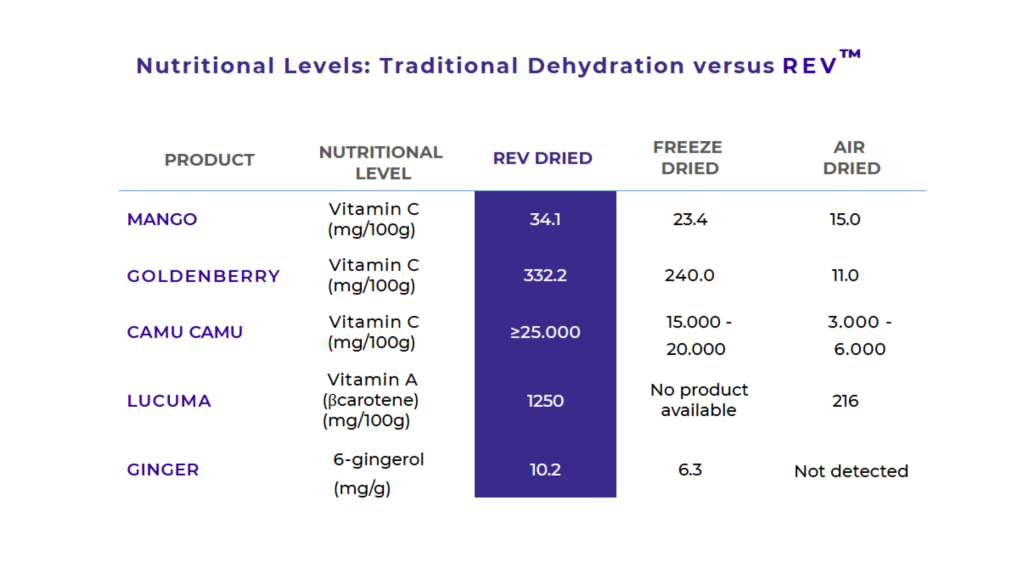
Sometimes. In the Mohammadi study, freeze-dried carrots retained more beta-carotene and freeze-dried products had the best rehydration. REV™ results were competitive for the nutritional values studied and substantially better than air drying, while also achieving the highest sensory scores under those protocols.
What does water activity mean in dried foods?
Water activity indicates how available water is for microbial growth and chemical or physical change. It is different from total moisture content and should be measured independently when establishing a drying endpoint.
How do manufacturers confirm nutrient retention?
Manufacturers compare representative samples before and after processing using validated analytical methods. Testing should be paired with moisture, water activity, sensory, packaging, shelf-life, and production-consistency assessments.
Dry better with a product-specific process
For food manufacturers evaluating commercial food drying, microwave drying equipment, or alternatives to commercial freeze drying, EnWave offers product-development trials and scalable REV™ platforms. Work with our team to define your product’s priority attributes, test a controlled drying protocol, and determine whether vacuum microwave dehydration fits your technical and commercial goals.
Explore REV™ technology or contact EnWave to discuss your application.
Further Reading

