

Vacuum Microwave Dehydration Vs Freeze Drying: Which Preserves Nutrients Better?
Vacuum microwave dehydration and commercial freeze drying both excel at nutrient preservation compared to high‑heat methods. Each shines in specific areas like vitamins, antioxidants, proteins, flavor, and color, depending on the product and goals. Food processors often choose based on trade‑offs between time, energy, texture, and scale.
Quick Overview
Freeze drying leads for structure and rehydration in delicate items. Vacuum microwave drying (such as EnWave’s REV™ system) matches or beats it on flavor, color, and bioactive retention for many snacks and ingredients, while cutting drying cycles from days to as little as minutes. Both retain 80–95 percent of key nutrients, but vacuum microwave offers significantly higher efficiency, throughput, and modular scalability for high‑volume food innovation.
How Do Both Methods Preserve Water‑Soluble Vitamins?
Both vacuum microwave dehydration and freeze drying preserve water‑soluble vitamins like vitamin C and B vitamins well. Freeze drying avoids the liquid phase, minimizing leaching. Vacuum microwave uses precise low temperatures and very short cycles, limiting degradation.
Studies on fruits show freeze drying retains about 85–95% vitamin C. Vacuum microwave achieves 80–92%, depending on product and conditions—sometimes higher due to less oxidation in the low-oxygen environment. Both are vastly superior to air drying (50–70% nutrient loss).
What About Fat‑Soluble Vitamins And Antioxidants?
Fat‑soluble vitamins (A, D, E, K) and antioxidants fare similarly. Freeze drying protects through low temperature and absence of liquid. Vacuum microwave retains them via rapid, uniform drying and low oxygen exposure.
For berries, freeze drying keeps 90% anthocyanins; vacuum microwave retains 85–95%, with some studies showing higher total phenolic content due to more uniform dehydration. Both outperform spray drying (60–80% retention).
How Do They Handle Protein Quality And Functionality?
Proteins denature with excessive heat or shear. Freeze drying minimizes this at subzero temperatures. Vacuum microwave drying keeps product below 60°C, preserving protein structure.
For dairy snacks like cheese, vacuum microwave (as with Moon Cheese) achieves a crunchy, high-protein snack with preserved functionality. Freeze drying is generally preferred for applications where rehydration is needed, such as powdered cheese or yogurt.
Why Does Flavor Retention Differ Between The Two?
Flavor volatiles can slowly escape and oxidize during the long freeze drying process. The closed, low‑oxygen, rapid drying cycle in vacuum microwave traps more flavor compounds.
REV™ vacuum microwave, in particular, allows for strong, bold flavors and crispy textures in products like Moon Cheese. Freeze drying preserves flavor but can mute some delicate notes due to extended cycles.
What Color Preservation Outcomes Can You Expect?
Color degrades from oxidation or Maillard reactions. Freeze drying excels at vibrant retention through low heat. Vacuum microwave matches or exceeds this with low temperature and oxygen control, frequently intensifying colors in fruits and vegetables.
How Do Drying Times Affect Overall Nutrient Integrity?
Long freeze drying cycles (24–48 hours) may risk slow oxidation and some additional nutrient loss. Vacuum microwave finishes drying in 30–90 minutes or less, often up to 25x faster, thus greatly reducing nutrient exposure.
When Does Freeze Drying Have The Edge On Nutrient Preservation?
Freeze drying wins for products needing perfect rehydration and intact structure (such as whole fruits, rehydrated meals, or pharmaceutical products). No liquid phase means minimal leaching, and it retains about 90–97% of heat‑sensitive vitamins in ideal conditions.
When Does Vacuum Microwave Dehydration Pull Ahead?
Vacuum microwave suits high‑volume snacks and ingredients where flavor, color, and texture are primary considerations. Short cycles better preserve volatiles and are easily scalable for rapid product innovation.
EnWave’s REV™ technology is proven for snacks like cheese and a wide variety of fruits and vegetables, where crunchy texture, strong color, and taste are premium features. Note: Some extremely high-moisture or low-solid foods may not be well suited for VMD.
Direct Comparison Table For Key Nutrients
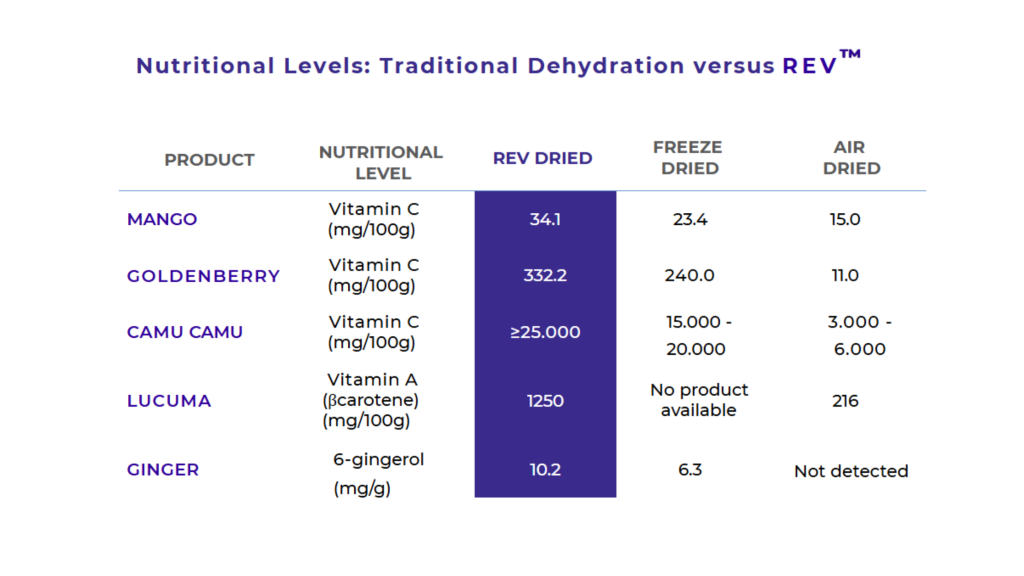
- Note: Actual retention levels may vary by product and process specifics.
How Do Real Products Show Nutrient Differences?
Moon Cheese uses REV™ vacuum microwave for intense dairy protein and flavor with a crunchy bite. Yogurt snacks retain probiotics and bioactives.
Freeze‑dried berries excel in structure/rehydration, while vacuum microwave creates crispy snackable fruits.
What Testing Validates Nutrient Claims?
HPLC for vitamins, DPPH for antioxidants, SDS‑PAGE for proteins, sensory panels for flavor, and colorimeters for hue. Independent labs routinely confirm both VMD and freeze drying outperform high-heat convection drying.
Why Consider Vacuum Microwave For Food Processing Scale?
Vacuum microwave dehydration is highly modular and scalable, from pilot scale to high-volume commercial output. Short cycles and lower energy usage are well suited to better-for-you snacking, while freeze drying remains best for structure-critical or niche products.
Product Development Implications For Nutrient-Focused Snacks
Test both for your product. Vacuum microwave enables rapid iteration and flavor-rich, shelf-stable snacks. Freeze drying is optimal for rehydratable, structure-sensitive items. Sometimes, process hybrids offer the best of both technologies.
FAQ
Which preserves vitamins better, vacuum microwave or freeze drying?
Freeze drying slightly outperforms for water‑soluble vitamins; vacuum microwave is close, and much faster.
How do they compare on antioxidants?
Comparable, both offer 85–95% retention, with occasional higher phenolic retention using vacuum microwave.
Does vacuum microwave denature proteins?
Minimal effect at 30–60°C; it matches freeze drying for solubility of proteins.
Which keeps flavor better?
Vacuum microwave often superior due to short drying cycles and low-oxygen processing.
What about color preservation?
Both methods produce vibrant, appealing colors, especially in fruits and vegetables.
Is vacuum microwave energy efficient?
Yes, typically 0.8–1 kWh/kg water vs. freeze drying’s 8–15 kWh/kg.
When to choose freeze drying over vacuum microwave?
When rehydrated texture/structure is the top priority (meals, pharmaceutical, certain produce).
Can vacuum microwave scale for commercial food drying?
Yes, modular technology supports scalable continuous production.
How to test nutrient retention?
Use laboratory methods like HPLC, DPPH, and sensory/color analysis. Both methods show far higher retention than conventional hot air drying.
Do both beat air drying?
Yes; both retain 80–95% of nutrients compared to air’s 50–70%.
Further reading
EnWave Dehydrating Vs Freeze Drying
PMC Microwave Dehydration Advances
https://pmc.ncbi.nlm.nih.gov/articles/PMC4076997
PubMed Microwave Drying Food Materials
https://pubmed.ncbi.nlm.nih.gov/41090454
PMC Comparative Microwave Drying
https://pmc.ncbi.nlm.nih.gov/articles/PMC10138014
Ferrite Microwave Drying