

How Encapsulated Ingredients React to Dehydration
Encapsulated ingredients can be highly sensitive to heat, moisture, and long drying times. The best dehydration system for encapsulated food ingredients is one that protects wall integrity, limits volatile loss, and gives manufacturers tight control over final moisture. For food and nutraceutical R&D teams, the drying method directly affects ingredient stability, release behavior, and shelf life.
Why Do Encapsulated Ingredients Need Special Drying Conditions?
Encapsulated ingredients are designed to protect something valuable inside. That might be a flavor, probiotic, vitamin, oil, or bioactive compound. If the drying step is too aggressive, the wall can crack, soften, collapse, or become less effective at holding the core material.
That is why encapsulated ingredient drying needs more than basic food dehydration. It has to manage heat, moisture, and mechanical stress together. A drying process that looks efficient on paper can still damage the final powder if the capsule structure is not respected.
What Happens to Wall Integrity During Drying?
Wall integrity is often the first thing to suffer when dehydration is not well controlled. Excess heat, uneven airflow, or long exposure times can weaken the matrix that holds the active ingredient in place. Once that structure is compromised, the ingredient may leak, clump, or lose its intended release profile.
This matters most for food innovation and product development teams because wall damage changes how the product performs after processing. A powder that was supposed to protect flavor or probiotics may no longer do so once the wall structure has been stressed. In practical terms, dehydration process optimization is partly about preserving the shell, not only removing water.
How Does Dehydration Affect Volatile Retention?
Volatile compounds are among the easiest components to lose during drying. Flavors, aromas, and some bioactives can escape when the process runs too hot or too long. That is especially important in encapsulated systems because the whole point of microencapsulation is often to retain those delicate compounds until use.
A gentler process lowers the chance of volatilization. Microwave drying equipment used under vacuum can help reduce exposure time and limit the conditions that drive aromatic loss. For manufacturers, that can make the difference between a premium ingredient and one that performs inconsistently in the final formulation.
Why Does Moisture Control Matter So Much?
Moisture control is central to encapsulated ingredient drying because too much moisture can shorten shelf life, while too little can damage the structure or create processing issues downstream. Encapsulated powders need a final moisture level that supports storage stability without compromising the wall material.
That balance is why moisture monitoring and control should be built into the process, not added after the fact. The better the system can control final moisture, the more predictable the ingredient will be during packaging, shipping, and use in formulations. For nutraceutical R&D leaders, this is especially important because ingredient performance often depends on consistency batch after batch.
How Do Spray Drying, Fluid Bed Drying, and Freeze Drying Compare?
Spray drying is widely used for encapsulation because it is fast and efficient for liquid feed systems. It works well when the formulation is designed for atomization, but the heat load and rapid process conditions can challenge more sensitive cores and some wall systems. For that reason, spray drying equipment is often the benchmark, but not always the best fit for every encapsulated ingredient.
Fluid bed drying for encapsulated powders is useful as a finishing step or for granules that need moisture reduction after formation. It can improve flow and reduce residual moisture, but it does not always solve the core issue of protecting fragile actives during the main drying phase. Freeze drying for microencapsulation offers strong protection and good structural retention, but it is slower and often harder to scale efficiently.
Where Does REV™ Fit In?
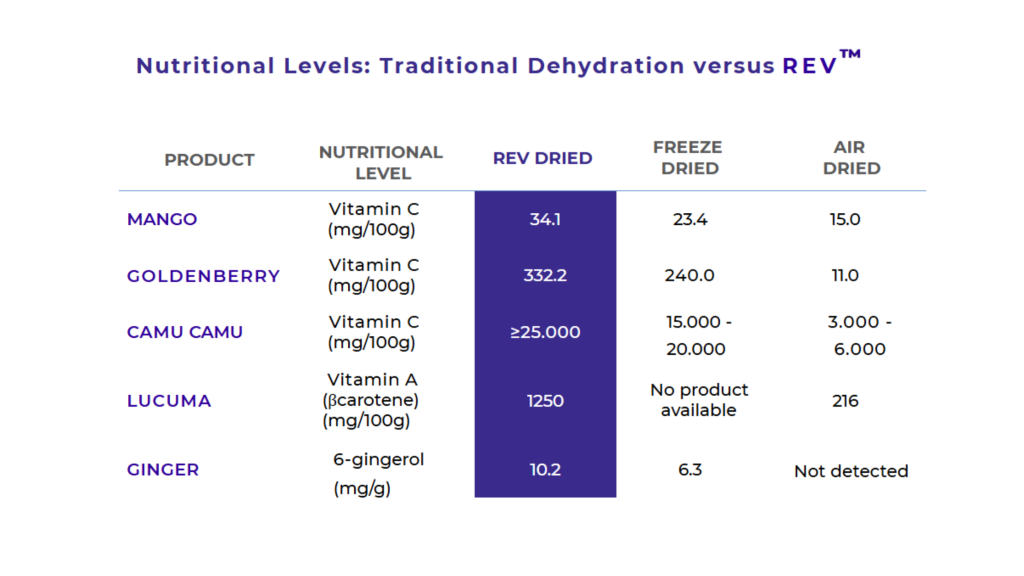
REV™ offers a useful alternative when the goal is to protect encapsulated ingredients while still improving throughput. REV™ is a vacuum microwave process that controls pressure and microwave power density to manage temperature and final moisture. That combination is attractive for ingredients that need gentler treatment than conventional hot-air methods.
For many teams, the appeal is in dehydration system for encapsulated food ingredients use cases where speed, structure, and stability all matter. REV™ can support solid materials, powders, and encapsulated formats without forcing manufacturers into the longest cycle times associated with commercial freeze drying. That makes it relevant for food tech teams looking at both performance and scale.
What Should R&D Teams Look For in Dehydration Process Optimization?
R&D teams should look for a system that can hold a consistent thermal profile, maintain low oxygen exposure, and deliver repeatable final moisture. They should also pay attention to how the process affects particle structure and whether the wall material remains intact after drying. These details are often what separate a workable prototype from a commercial product.
A good test plan should include several checkpoints.
- Measure wall integrity before and after drying.
- Track volatile retention where flavor or aroma matters.
- Verify moisture content and water activity.
- Compare performance across pilot and production scale.
- Confirm how the ingredient behaves in the final food or supplement application.
Those steps help turn encapsulated ingredient drying into a controlled development process rather than a guessing exercise.
Why Is Scale-Up So Difficult for Encapsulated Powders?
Scale-up is difficult because encapsulated powders do not always behave the same way at larger volumes. A process that preserves structure in a small trial may create overheating, clumping, or uneven moisture removal when the batch gets bigger. This is a common reason why commercial food drying projects lose time in late-stage development.
That is why scalable dehydration technology matters so much. If the same drying logic can be carried from pilot to production, the risk of rework drops. EnWave’s REV technology is positioned around that need, especially for teams trying to commercialize food and nutraceutical ingredients with predictable quality.
What Does Good Encapsulated Ingredient Drying Look Like in Practice?
Good encapsulated ingredient drying leaves the wall intact, protects the core, and produces a stable powder that behaves as expected in the final product. It should not force the team to choose between quality and speed. The best drying method finds a balance between the two.
In practice, that means fewer broken capsules, lower volatility loss, and a cleaner path to shelf stability. It also means more confidence during food product development, because the ingredient stays closer to its intended design. For food and nutraceutical manufacturers, that can protect both product performance and brand value.
Why Does This Matter for Food Innovation?
Encapsulated ingredients are often used to make products more stable, more flavorful, or more functional. That means the drying process is part of the innovation itself. If the drying step damages the ingredient, the innovation loses value before it reaches the customer.
That is why many teams now evaluate drying technology alongside formulation. In food processing and food innovation, the drying method can change whether a concept is commercially viable. A better dehydration system for encapsulated food ingredients can make it easier to scale new products with fewer compromises.
Conclusion
Encapsulated ingredients react strongly to dehydration method and process conditions. Wall integrity, volatile retention, and moisture control all shape the final performance of the ingredient. For R&D leaders comparing spray drying equipment, freeze drying for microencapsulation, fluid bed drying for encapsulated powders, and alternative systems like REV, the right choice depends on how much protection the ingredient needs and how fast the business needs to scale.
FAQ
What is the best dehydration system for encapsulated food ingredients?
The best system is one that protects wall integrity, limits volatile loss, and gives tight moisture control.
How does spray drying affect encapsulated ingredients?
Spray drying is fast and widely used, but heat and atomization can challenge sensitive cores and wall materials.
Is freeze drying better for microencapsulation?
Freeze drying can preserve structure well, but it is slower and less efficient for many commercial applications.
What does fluid bed drying do for encapsulated powders?
It is often used to reduce residual moisture and improve flow, especially as a finishing step.
Why is moisture control important in encapsulated ingredient drying?
It affects shelf life, structure, and how the ingredient performs in the final product.
Further reading
EnWave What is REV
EnWave What is the best alternative to a freeze dryer
https://www.enwave.net/ja/what-is-the-best-alternative-to-a-freeze-dryer
EnWave How is microwave dehydration changing the food industry
EnWave Drying method limitations air, spray and freeze drying
Microwave Technology for Dehydration
https://kerone.com/blog/microwave-technology-for-dehydration
Low temperature desiccant based food drying system
https://www.sciencedirect.com/science/article/abs/pii/S0260877405002098
Optimizing the quality of frozen foods with REV technology
EnWave quantaREV announcement